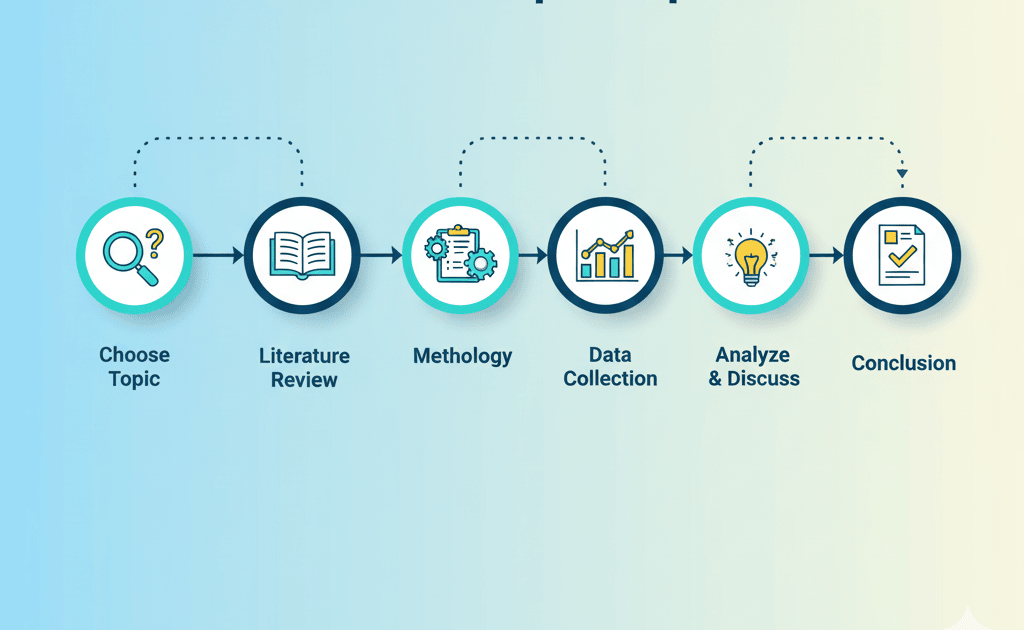
At Mars Publications, our Education Research Paper Writing Services are designed to help authors navigate this process with clarity and confidence. In this comprehensive guide, we’ll walk you through every step of writing an effective education research paper, from planning to submission, while ensuring academic precision, clarity, and structure.
Start with a Clear Research Question
A well-defined research question is the foundation of every effective education paper. It guides your study design, data collection, and overall argument. Instead of choosing a broad topic like “classroom engagement,” narrow it to something measurable, such as “How does gamified learning affect student engagement in high school classrooms?”
Ask yourself:
- What specific problem am I addressing?
- Why is this issue relevant to educational practice or policy?
- How can my research contribute to the field?
A precise research question not only makes writing easier but also increases your paper’s publication potential in teacher education journals and academic education journals.
Conduct a Thorough Literature Review
An education research paper must build upon existing knowledge. Conduct a structured literature review to understand the existing studies and determine where your research fits.
Search databases like ERIC, Scopus, and Google Scholar. Organize your findings by theme, such as curriculum, pedagogy, student motivation, and technology in learning, among others. Summarize key trends and identify gaps in the literature that justify your study.
Your literature review should demonstrate:
- Awareness of current research trends.
- Understanding of theoretical frameworks (e.g., constructivism, behaviorism).
- A clear justification for your study’s originality.
At Mars Publications, our academic writing support team helps researchers refine their literature reviews with a logical flow, critical synthesis, and accurate citation formatting.
Choose an Appropriate Research Methodology
Your methodology defines how credible and reproducible your study will be. In education research, methodologies often fall into three categories:
- Quantitative: Uses surveys, assessments, and statistics to measure variables.
- Qualitative: Focuses on interviews, case studies, and thematic analysis to explore experiences.
- Mixed Methods: Combines both approaches for richer insights.
Be transparent about your methods. Describe how participants were selected, how data were collected, and which tools or tests were used.
Clarity is crucial here; reviewers reject many manuscripts because the methodology section is unclear. If you’re unsure how to structure this part, Mars Publications’ Research Methodology in Education experts can guide you in writing precise, replicable descriptions.
Structure Your Paper Effectively
A well-structured education paper allows readers and reviewers to follow your argument smoothly. Most journals in the education field follow a standard IMRaD format (Introduction, Methods, Results, and Discussion).
Here’s a simplified breakdown:
Abstract: 150–250 words summarizing your study’s objective, design, results, and conclusions.
Introduction: Define the research problem, provide background, and state the research question.Methodology: Explain your research design, participants, instruments, and analysis.
Results: Present findings objectively using tables, charts, and summaries.
Discussion: Interpret the results, relate them to previous studies, and discuss implications.
Conclusion: Summarize the contributions, limitations, and provide suggestions for future research.
Professional editors at Mars Publications ensure every section is cohesive and aligns with the scientific paper structure expected by international journals.
Write with Clarity
Education research aims to inform, not confuse. Use simple, academic language to communicate your ideas clearly. Avoid filler words and repetitive statements. Each paragraph should have a single main idea supported by evidence or data.
Example:
Instead of writing “The findings seem to suggest that the students might have improved due to the intervention,” write “The intervention improved student performance.”
Keep sentences short (15–20 words on average) and maintain a logical flow between paragraphs using transition phrases like “In contrast,” “Furthermore,” or “This finding supports…”
At Mars Publications, our Education Research Paper Writing Services prioritize enhancing readability and language precision while maintaining an academic tone.
Apply APA Formatting Correctly
APA formatting (7th edition) is the standard for education papers. Proper formatting enhances professionalism and prevents desk rejection. Follow these basics:
- Use Times New Roman, 12-point font, and double spacing.
- Include 1-inch margins on all sides.
- Follow author-date citation style (e.g., Brown, 2022).
- List References alphabetically by author surname.
- Add headings and subheadings to structure sections.
If you’re unsure about APA guidelines, Mars Publications offers expert APA formatting for education papers to ensure your manuscript meets journal requirements.
Present Data Effectively
Data presentation can make or break your research paper. Use visual aids such as tables, graphs, and figures to clarify results, but only when they add value. Avoid overloading your results section with numbers that don’t directly answer your research question.
Each table or chart should have:
- A clear title.
- Consistent labeling.
- Brief explanatory captions.
- Reference in the main text (“As shown in Table 2…”).
Our editorial team specializes in formatting and refining data visualization for academic publications, making your results both professional and persuasive.
Maintain Objectivity and Academic Integrity
Educational research should remain unbiased. Avoid overstating findings or drawing conclusions beyond your data. Always acknowledge study limitations and suggest future areas for exploration.
Plagiarism is another common issue. Even unintentional similarities can harm your credibility. Run a plagiarism check and ensure proper paraphrasing and citation. Mars Publications’ plagiarism and similarity check services provide 100% originality before submission.
Revise and Edit Thoroughly
Never submit your first draft. Review it multiple times for clarity, coherence, and grammar. Reading aloud helps catch awkward phrasing. Ask colleagues or mentors to critique your work; they may spot issues you missed.
Professional editing can make the difference between rejection and acceptance. Our Education Research Paper Editing Services ensure consistency in tone, structure, and formatting while refining academic precision and fluency.
Prepare for Journal Submission
Before submitting your paper, review your target journal’s submission guidelines carefully. Each journal may have specific word limits, reference styles, or formatting rules. Prepare:
- A cover letter summarizing your research contribution.
- A formatted manuscript as per journal instructions.
- Supplementary materials (if required).
At Mars Publications, our experts provide comprehensive journal submission assistance, encompassing formatting, editing, and responding to reviewer comments.
Conclusion
Writing an effective research paper in education takes time, patience, and a deep understanding of academic conventions. From identifying the right topic to structuring arguments and applying correct formatting, each step contributes to your paper’s success.
With professional guidance from Mars Publications’ Education Research Paper Writing Services, you can transform your ideas into a polished, publishable manuscript that meets global academic standards. Remember, excellent educational research doesn’t just inform, it inspires better teaching, learning, and innovation across classrooms worldwide.