Qualitative research helps researchers understand people’s experiences, opinions, and behaviours. However, traditional qualitative analysis often takes months. Researchers must transcribe interviews, code every sentence, compare themes, and review findings several times. Rapid qualitative analysis produces rich insights, but it demands significant time and resources.
Many research projects cannot wait that long. Public health emergencies, healthcare improvement initiatives, policy evaluations, and implementation studies often require quick answers. Decision-makers need reliable evidence before opportunities disappear. As a result, researchers increasingly rely on rapid qualitative analysis methods.
Rapid qualitative analysis shortens the analysis process without sacrificing rigour. It focuses on answering clear research questions while maintaining transparency throughout the study. Instead of spending months on detailed coding, researchers organise information using structured summaries, matrices, and focused frameworks. Consequently, they deliver meaningful findings much faster.
Today, rapid qualitative analysis supports hospitals, government agencies, nonprofit organisations, universities, and private companies. It helps researchers evaluate programmes, improve services, and guide important decisions within tight deadlines.
This guide explains rapid qualitative analysis methods in simple language. You will learn when to use them, how they work, their advantages, limitations, and practical steps for conducting high-quality rapid analysis.
What Are Rapid Qualitative Analysis Methods?
Rapid qualitative analysis methods are structured approaches that help researchers analyse qualitative data quickly and systematically. These methods reduce the time between data collection and reporting while maintaining credible results.
Unlike traditional approaches, rapid analysis emphasises efficiency from the beginning. Researchers develop focused research questions, standardised templates, and predefined frameworks before collecting data. This preparation allows teams to organise information immediately after interviews or focus groups.
The goal is not to ignore important details. Instead, researchers prioritize information that directly answers their research questions.
For example, imagine a hospital introducing a new patient appointment system. Administrators want feedback within two weeks instead of three months. Researchers interview patients and staff, summarise each interview using structured templates, identify recurring themes, and present recommendations before the hospital expands the program.
Traditional analysis might require several months. Rapid qualitative analysis can often produce reliable findings within days or weeks.
Why Has Rapid Qualitative Analysis Become So Popular?
Research environments continue to change. Organisations now expect evidence faster than ever.
Healthcare leaders cannot delay patient safety improvements while researchers complete lengthy coding processes. Government agencies often need immediate feedback during disasters or public health outbreaks. Businesses also require quick customer insights before launching new products.
Rapid qualitative analysis addresses these challenges.
Several factors explain its growing popularity.
Faster Decision Making
Organisations often make decisions under strict deadlines. Rapid analysis provides evidence before those opportunities disappear.
Limited Research Budgets
Many projects receive limited funding. Shorter analysis periods reduce labour costs while still generating valuable findings.
Growing Demand for Implementation Research
Implementation science examines how programmes work in real settings. Researchers frequently need ongoing feedback throughout implementation. Rapid methods support continuous learning.
Better Team Collaboration
Modern research teams often include clinicians, policymakers, and community partners. Rapid analysis allows everyone to contribute throughout the research process.
Advances in Digital Technology
Digital recording, transcription software, cloud collaboration, and qualitative research tools streamline many research tasks. These technologies support efficient workflows.
What Makes Rapid Qualitative Analysis Different?
Many researchers assume rapid analysis simply means working faster. That assumption creates confusion.
Rapid qualitative analysis differs because researchers design the entire project around efficiency.
Traditional qualitative analysis usually follows an open exploration process. Researchers gradually develop codes while reviewing transcripts multiple times.
Rapid analysis begins with focused objectives.
Researchers know exactly what they want to learn before interviews begin. Consequently, every interview question serves a specific purpose.
The table below highlights key differences.
| Traditional Analysis | Rapid Qualitative Analysis |
| Open-ended exploration | Focused research questions |
| Extensive line-by-line coding | Structured summaries |
| Multiple coding cycles | Targeted framework analysis |
| Months of analysis | Days or weeks |
| Detailed transcript review | Matrix-based comparison |
| Broad theme development | Decision-focused findings |
Neither approach is universally better.
Instead, researchers should choose the method that best fits their research goals.
When Should Researchers Use Rapid Qualitative Analysis?
Rapid methods work well under specific conditions.
Researchers should choose them when timely information matters more than exhaustive interpretation.
Common situations include:
- Healthcare quality improvement
- Public health investigations
- Emergency response evaluations
- Policy implementation
- Community health assessments
- Educational program evaluations
- Nonprofit impact studies
- Customer experience research
- Service improvement projects
- Pilot program evaluations
For example, a public health department may launch a vaccination campaign. Officials need immediate feedback about community concerns. Waiting several months would reduce the campaign’s effectiveness.
Rapid qualitative analysis provides practical recommendations while the campaign continues.
When Traditional Analysis Remains the Better Choice?
Rapid methods do not fit every research project.
Some studies require deep theoretical interpretation that develops gradually over time.
Traditional qualitative analysis usually works better when researchers aim to:
- Build new theories
- Conduct grounded theory research
- Explore complex cultural meanings
- Produce detailed ethnographic studies
- Examine historical narratives
- Develop highly nuanced interpretations
Researchers should align their analytical approach with their research objectives rather than choosing the fastest method.
Core Principles of Rapid Qualitative Analysis
Successful rapid analysis follows several important principles.
These principles maintain research quality despite shorter timelines.
Focused Research Questions
Everything begins with clearly defined questions.
Broad questions create unnecessary work.
Specific questions improve efficiency.
For example:
Poor question:
“How do patients feel?”
Better question:
“What barriers prevent patients from attending follow-up appointments?”
Focused questions guide interviews, summaries, and final recommendations.
Standardized Data Collection
Researchers collect information consistently.
Interview guides remain structured.
Field notes follow similar formats.
This consistency simplifies later analysis.
Immediate Data Review
Researchers begin analysis immediately after each interview.
Waiting until every interview finishes creates unnecessary delays.
Early analysis also identifies missing information while researchers can still collect additional data.
Team-Based Collaboration
Rapid analysis often involves several researchers.
Each researcher summarises assigned interviews.
The team regularly compares findings.
These discussions improve consistency.
Transparent Documentation
Rapid research should never appear mysterious.
Researchers document every analytical decision.
This transparency increases credibility and trustworthiness.
Common Rapid Qualitative Analysis Methods
Researchers use several approaches depending on project goals.
Although each method differs slightly, all emphasise efficiency and structured analysis.
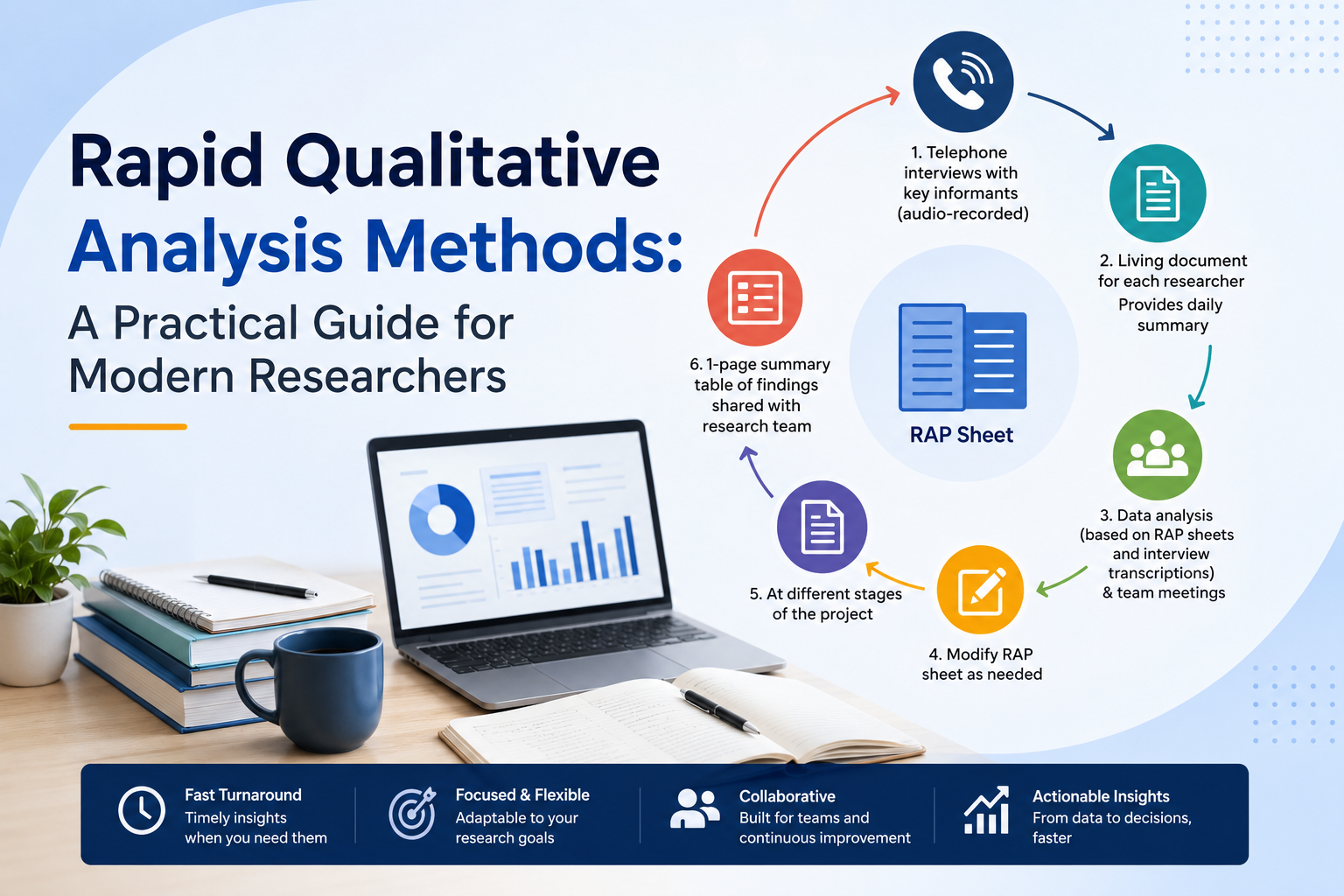
Rapid Assessment Procedures
Rapid Assessment Procedures, often called RAP, originated in public health and international development.
Researchers collect multiple data sources within short periods.
These sources often include:
- Interviews
- Observations
- Focus groups
- Existing documents
Researchers compare findings across different sources before developing conclusions.
This approach strengthens confidence because evidence comes from multiple perspectives.
Healthcare organisations frequently use RAP during disease outbreaks and emergency response planning.
Framework Analysis
Framework analysis remains one of the most widely used rapid qualitative analysis methods.
Researchers organise information into predefined categories.
Each participant receives a row.
Each research topic receives a column.
The completed matrix allows researchers to compare participants quickly.
Patterns become easier to identify.
Framework analysis works especially well for policy research, healthcare evaluation, and implementation science.
Matrix Analysis
Matrix analysis builds upon structured summaries.
Researchers organise participant responses into comparison tables.
For example:
| Participant | Main Challenge | Suggested Improvement |
| Patient A | Long waiting times | Online booking |
| Patient B | Poor communication | Text reminders |
| Patient C | Difficult parking | Shuttle service |
Even large studies become easier to interpret using organised matrices.
Decision-makers also appreciate matrix summaries because they communicate findings clearly.
Rapid Thematic Analysis
Rapid thematic analysis helps researchers identify meaningful patterns without completing extensive line-by-line coding. Instead, researchers focus on information that directly answers the study objectives.
This method works especially well when interview guides remain consistent across participants. Similar questions produce comparable responses. Therefore, researchers can identify recurring ideas much faster.
The process usually follows these steps:
- Review interview notes or transcripts.
- Summarise important responses.
- Group similar responses together.
- Identify recurring themes.
- Compare themes across participants.
- Refine findings through team discussion.
Unlike traditional thematic analysis, researchers avoid creating hundreds of detailed codes. Instead, they develop practical themes that support decision-making.
For example, researchers evaluating an online learning platform may identify themes such as:
- Technical barriers
- Instructor communication
- Student engagement
- Course flexibility
- Assessment challenges
These themes immediately highlight improvement opportunities.
Team-Based Rapid Analysis
Many rapid qualitative projects involve several researchers working together.
A collaborative approach speeds up analysis while improving consistency.
Each researcher usually completes structured summaries after every interview. The team then meets regularly to compare observations.
These meetings help researchers answer important questions.
- Are participants describing similar experiences?
- Are new themes appearing?
- Have researchers misunderstood any responses?
- Should interview questions change?
Frequent discussions improve accuracy throughout the project.
They also reduce individual bias because multiple researchers interpret the data together.
Healthcare implementation projects often depend on this collaborative approach. Clinical teams, administrators, and researchers each contribute different perspectives.
As a result, findings become more balanced and useful.
Step-by-Step Guide to Rapid Qualitative Analysis
Although every study differs, most successful projects follow a similar workflow.
Step 1: Define Clear Research Objectives
Everything starts with clear objectives.
Researchers should know exactly what information they need before collecting data.
Broad objectives create unnecessary work.
Focused objectives improve efficiency.
For example, instead of asking,
“How do employees feel?”
A better objective would be,
“What barriers prevent employees from using the new reporting system?”
Specific objectives simplify every later stage.
Step 2: Design a Structured Interview Guide
Interview questions should align with research objectives.
Every question should serve a purpose.
Researchers should avoid collecting information that will never appear in the final report.
Structured interviews also make participant comparisons easier.
Suppose every participant answers identical core questions.
Researchers can immediately organise responses into matrices without extensive transcript review.
Step 3: Collect Data Efficiently
Rapid analysis begins during data collection.
Researchers should take detailed field notes during interviews.
Many teams also create interview summaries immediately afterward.
Fresh memories improve summary quality.
Waiting several days often causes researchers to forget important observations.
Digital voice recordings remain valuable. However, researchers do not always need complete verbatim transcripts.
Focused summaries often provide enough information.
This approach saves considerable time.
Step 4: Develop Summary Templates
Consistency matters.
Researchers should summarise every interview using the same template.
A simple template might include:
| Section | Description |
| Participant ID | Anonymous identifier |
| Key findings | Main responses |
| Barriers | Reported challenges |
| Facilitators | Positive experiences |
| Recommendations | Participant suggestions |
| Important quotes | Supporting evidence |
Templates make later comparisons much easier.
Step 5: Build Analytical Matrices
Matrices form the backbone of many rapid qualitative projects.
Researchers transfer summarised information into comparison tables.
For example:
| Participant | Barrier | Suggested Solution |
| Nurse 1 | Staff shortage | Hire temporary staff |
| Nurse 2 | Poor scheduling | Flexible shifts |
| Nurse 3 | Limited training | Monthly workshops |
Patterns become visible almost immediately.
Decision makers appreciate this format because it supports quick interpretation.
Step 6: Identify Recurring Themes
Researchers now review the completed matrices.
They ask several questions.
Which barriers appear repeatedly?
Also, which recommendations receive the strongest support?
Which opinions differ across participant groups?
Themes should emerge naturally from the collected evidence.
Researchers should avoid forcing data into predetermined conclusions.
Step 7: Validate Findings
Rapid analysis still requires quality checks.
Researchers should compare findings across team members.
Whenever possible, they should also compare multiple data sources.
Suppose interview findings match observation notes.
Confidence increases.
Suppose focus group discussions contradict interviews.
Researchers should investigate further before reporting conclusions.
Triangulation strengthens credibility.
Step 8: Prepare Actionable Reports
Many rapid projects exist to support immediate decisions.
Therefore, reports should focus on practical recommendations.
Busy decision-makers rarely want lengthy theoretical discussions.
Instead, they need answers.
Good reports include:
- Main findings
- Supporting evidence
- Practical recommendations
- Implementation priorities
- Suggested next steps
Simple language improves usability.
Data Reduction Without Losing Important Information
One common concern involves losing valuable detail.
Researchers sometimes worry that faster analysis reduces research quality.
Good rapid analysis avoids this problem through careful data reduction.
Data reduction does not mean deleting information.
Instead, researchers organise information more efficiently.
Several techniques help achieve this balance.
Focus on Research Questions
Every finding should connect directly to a research objective.
Information outside the project scope may remain interesting.
However, it should not dominate analysis.
Remove Repetition
Participants often express similar opinions using different words.
Researchers summarise repeated ideas together.
This approach keeps reports concise without losing meaning.
Prioritize Strong Evidence
Researchers should emphasise themes supported by multiple participants.
One isolated opinion rarely deserves equal attention.
However, unusual findings should still appear if they reveal important risks or opportunities.
Common Data Sources
Rapid qualitative analysis works with many different forms of qualitative data.
Researchers often combine several sources.
These include:
Interviews: Individual interviews provide detailed personal experiences.
Focus Groups: Group discussions reveal shared opinions and disagreements.
Observations: Researchers observe behaviours instead of relying only on self-reports.
Documents: Policies, reports, meeting notes, and organisational records provide useful background.
Open-Ended Survey Responses: Many organisations collect written comments through online surveys.
Researchers can analyse these responses rapidly using matrices and structured summaries. Combining multiple sources improves confidence in the final findings.
Tools That Support Rapid Qualitative Analysis
Modern software makes rapid analysis even more efficient.
Researchers should choose tools based on project size, budget, and complexity.
Microsoft Excel
Excel remains one of the most popular rapid analysis tools.
Many researchers already know how to use it.
Excel supports:
- Data matrices
- Sorting responses
- Filtering themes
- Frequency summaries
- Team collaboration
Small and medium projects often require nothing more.
Microsoft Word
Word works well for interview summaries and structured templates.
Researchers can organise findings under predefined headings.
Many healthcare teams use Word because every organisation already owns it.
NVivo
NVivo supports larger qualitative projects.
Researchers can organise interviews, assign codes, compare participant groups, and visualise findings.
Although NVivo offers advanced features, researchers should avoid unnecessary complexity during rapid studies.
Simple coding often works better.
MAXQDA
MAXQDA combines qualitative and quantitative analysis.
Its visualisation tools help researchers identify patterns quickly.
Implementation researchers frequently choose MAXQDA because it supports team collaboration.
Dedoose
Dedoose operates through the cloud.
Research teams working across different locations can collaborate in real time.
This flexibility improves productivity during fast-moving projects.
Rapid Qualitative Analysis in Healthcare
Healthcare organisations increasingly rely on rapid qualitative analysis to improve patient care. Clinical environments change quickly. Therefore, leaders often need evidence within days instead of months.
Researchers use rapid analysis to evaluate new services, identify workflow problems, and understand patient experiences. They can also assess staff feedback before expanding new initiatives.
For example, a hospital may introduce virtual consultations. Administrators want to know whether patients find the system easy to use. Researchers interview physicians, nurses, and patients over two weeks. Next, they summarise each interview using structured templates. Finally, they compare responses through analytical matrices.
The findings may reveal several recurring issues.
- Older patients struggle with video technology.
- Appointment reminders reduce missed visits.
- Physicians appreciate shorter administrative tasks.
- Patients value flexible scheduling.
Hospital leaders can immediately address these issues instead of waiting months for a traditional analysis.
Public Health Applications
Public health researchers often work under strict deadlines. Disease outbreaks, vaccination campaigns, and emergency responses demand timely evidence.
Rapid qualitative analysis supports these efforts by providing practical insights while programmes remain active.
Imagine a local health department launches a childhood vaccination campaign. Officials notice lower participation in several communities. They need answers before the campaign ends.
Researchers interview parents, healthcare workers, and community leaders. They organize responses into matrices and identify common barriers.
The analysis may show that misinformation spreads through social media. It may also reveal transportation challenges or language barriers.
Officials can respond immediately with targeted education and mobile vaccination clinics.
Without rapid analysis, these opportunities may disappear.
Implementation Science
Implementation science studies how evidence-based practices succeed in real-world settings.
Even the best intervention can fail if organisations implement it poorly.
Rapid qualitative analysis helps researchers identify implementation challenges early.
Researchers often examine questions such as:
- Do staff understand the new process?
- Which barriers slow implementation?
- What resources remain unavailable?
- Which departments adapt more successfully?
These findings support continuous improvement throughout the project.
Instead of waiting until implementation ends, organisations adjust strategies while progress continues.
Program Evaluation
Government agencies and nonprofit organisations frequently evaluate community programs.
Many funding organisations require quick evidence before approving future investments.
Rapid qualitative analysis allows evaluators to collect meaningful feedback without delaying decisions.
For example, a non-profit launches a youth employment program.
Researchers interview participants after three months.
Common themes may include:
- Increased confidence
- Better interview skills
- Limited transportation
- Strong mentor relationships
- Need for additional training
Program managers can improve future sessions based on these findings.
A Practical Example
Consider a university introducing a new mental health support service.
The research team wants to understand student experiences within one month.
Research Question
What factors influence student satisfaction with the new counselling service?
Participants
- Undergraduate students
- Graduate students
- Counselors
- Administrative staff
Data Collection
Researchers conduct twenty interviews.
Each interview lasts thirty minutes.
Researchers prepare structured summaries immediately afterward.
Matrix Development
The research team creates comparison tables using predefined categories.
| Participant | Positive Experience | Challenge | Recommendation |
| Student 1 | Friendly staff | Long waiting time | More counselors |
| Student 2 | Easy booking | Limited evening appointments | Extended hours |
| Counselor | Better scheduling | Heavy workload | Additional staff |
Theme Development
After reviewing every summary, several themes appear consistently.
- Accessibility
- Waiting times
- Staff communication
- Appointment flexibility
- Student awareness
Recommendations
Researchers recommend:
- Hiring additional counsellors.
- Offering evening appointments.
- Improving campus awareness campaigns.
- Simplifying online booking.
University leaders receive actionable findings within four weeks.
A traditional analysis might require several additional months.
Advantages of Rapid Qualitative Analysis
Rapid qualitative analysis offers many benefits when researchers apply it appropriately.
Faster Results
The greatest advantage involves speed.
Organisations receive evidence while decisions still matter.
Lower Costs
Shorter analysis periods reduce labor expenses.
Smaller research budgets can still support meaningful studies.
Better Decision Support
Rapid findings help leaders respond quickly.
Organisations can improve programmes before problems become larger.
Continuous Learning
Rapid analysis encourages ongoing evaluation.
Researchers can collect feedback throughout implementation instead of waiting until projects finish.
Improved Collaboration
Research teams regularly discuss findings.
This collaboration strengthens consistency and reduces individual interpretation errors.
Practical Recommendations
Rapid analysis focuses on actionable findings.
Decision makers often value practical recommendations more than lengthy theoretical discussions.
Limitations of Rapid Qualitative Analysis
Although rapid methods provide many benefits, they also have limitations.
Researchers should recognise these challenges before selecting an analytical approach.
Less Interpretive Depth
Rapid analysis emphasises efficiency.
Researchers may not explore every subtle meaning within participant responses.
Risk of Oversimplification
Poorly designed projects sometimes reduce complex experiences into overly simple themes.
Researchers should avoid excessive data reduction.
Greater Dependence on Planning
Rapid projects require careful preparation.
Weak interview guides create weak findings.
Good planning remains essential.
Team Training
Researchers should receive consistent training before beginning analysis.
Different interpretations reduce reliability.
Limited Suitability
Rapid analysis does not fit every study.
Theory development and ethnographic research often require slower, more detailed approaches.
Common Mistakes Researchers Should Avoid
Several mistakes reduce the quality of rapid qualitative analysis.
Fortunately, researchers can avoid most of them through careful planning.
Starting Without Clear Questions
Unfocused research creates unnecessary work.
Researchers should define objectives before collecting data.
Collecting Too Much Information
Every interview question should support the study objectives.
Extra information increases workload without improving findings.
Ignoring Data Quality
Rapid does not mean careless.
Researchers should still collect detailed notes and accurate recordings.
Skipping Team Discussions
Collaborative reviews improve consistency.
Researchers should discuss emerging themes throughout the project.
Reporting Weak Evidence
Strong recommendations require strong evidence.
Researchers should avoid conclusions based on isolated opinions.
Best Practices
Researchers can improve study quality by following several practical recommendations.
- Develop focused research questions.
- Create standardised interview guides.
- Summarise interviews immediately.
- Use structured templates.
- Build comparison matrices.
- Hold regular team meetings.
- Compare multiple data sources.
- Document analytical decisions.
- Focus on actionable findings.
- Report limitations honestly.
These practices improve credibility while maintaining efficiency.
Frequently Asked Questions
What is rapid qualitative analysis?
Rapid qualitative analysis is a structured approach that helps researchers analyze qualitative data quickly while maintaining methodological rigour.
How long does rapid qualitative analysis take?
Many projects finish within several days or weeks. The exact timeline depends on study size, participant numbers, and available researchers.
Is rapid qualitative analysis reliable?
Yes, when researchers use structured methods, standardised templates, team discussions, and transparent documentation.
Can researchers use software for rapid analysis?
Yes. Excel, Word, NVivo, MAXQDA, and Dedoose all support rapid qualitative analysis.
Does rapid analysis replace traditional qualitative research?
No. Each method serves different research goals. Researchers should choose the approach that best matches their objectives.
Which industries use rapid qualitative analysis?
Healthcare, public health, education, non-profit organisations, government agencies, implementation science, business research, and community development all use rapid qualitative analysis.
Conclusion
Rapid qualitative analysis methods have transformed modern qualitative research. Organisations no longer need to choose between speed and meaningful insights. With careful planning, structured workflows, and transparent reporting, researchers can deliver reliable evidence within practical timelines.
The key lies in preparation. Clear research questions, consistent data collection, standardised summaries, and collaborative analysis all contribute to trustworthy findings. Researchers who follow these principles can support faster decisions without compromising research quality.
Mars Publications assist researchers with Technical and Subject Matter Editing Services, reach out today to navigate the research process smoothly.