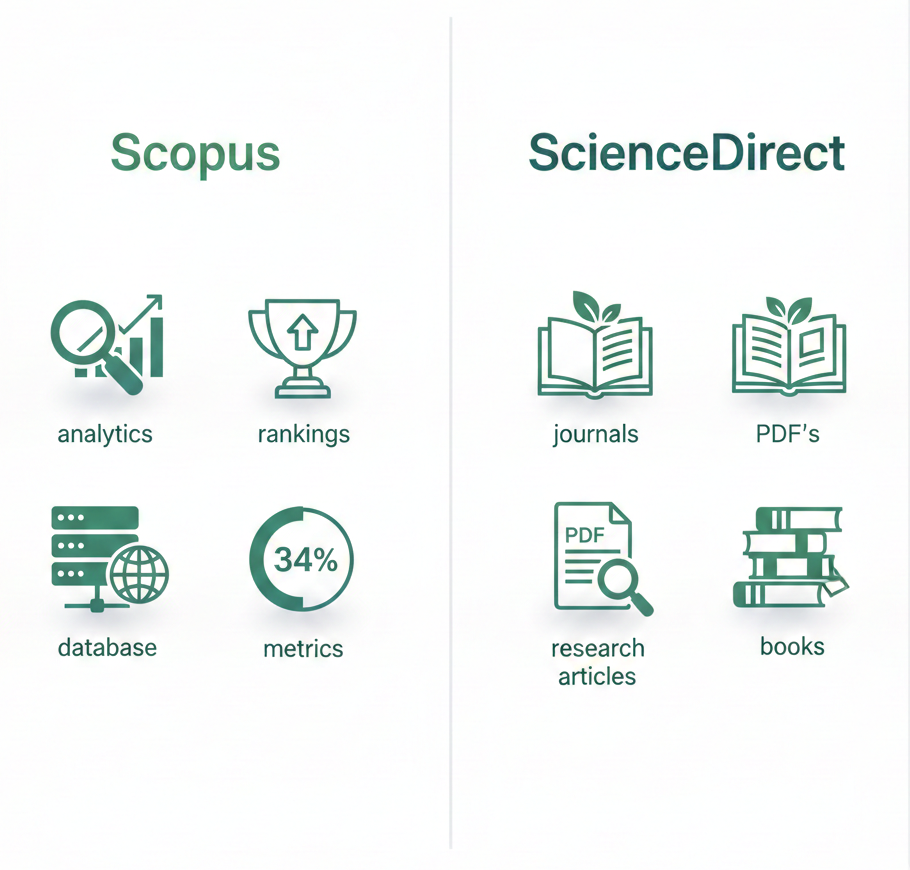
The modern researcher is under the pressure to write quality work and refer to the most authoritative sources. This implies a proper utilization of the best academic materials that are out there i.e. Scopus and ScienceDirect. They are both giants in the academic community, owned by publishing house Elsevier, but their core functions and purposes are entirely different in your research process, and serve a crucial use in your research process.
It is easy to mix up the two tools and get ineffective searching of literature and poor decision-making on the choice of journals. To manage your time efficiently and the most of your academic effect, you need to know their specific functions.
Mars Publications is focused on empowering the authors by demystifying the publishing ecosystem. We differentiate between these tools; we make sure you employ all of them in a strategic manner. Continue reading to drive the differences necessary and smooth your way to publication.
Scopus: The Ultimate Indexing and Citation Solution
Imagine Scopus as the best librarian and the best impact analyst of the scholarly literature in the world. It does not actually store the full-text articles, but mainly indexes and abstracts them. In 2004 Scopus was launched with a design to give a complete and curated view of the world research output.
Function: A Large Abstract and Citation Database
Scopus is a database that runs as the biggest curated abstract and citation database worldwide. It does compile metadata, names of titles, name of authors, name of keywords, name of abstracts of a very huge interdisciplinary body of peer-reviewed literature. More importantly, it searches the work of more than 5,000 global publishers, not only of Elsevier, providing it with wide, source-neutral coverage. This extensive coverage renders Scopus an essential instrument in the process of performing extensive literature reviews as well as systematic analyses in all significant areas of study such as science, technology, medicine, social sciences as well as humanities.
Output: Impact Metrics and Analytics
The best thing that you will get out of Scopus is the bibliometric and analytical tools. Researchers use Scopus to:
Track Citations: You will be able to know who mentioned your work and in what articles you need to refer to.
Evaluate Journal Impact Scopus offers essential, publisher-neutral figures such as CiteScore, SJR (SCImago Journal Rank), and SNIP (Source Normalized Impact per Paper). These measures are used by you to assess the quality of journals and make wise decisions of where to submit your manuscript so as to give it the greatest impact.
Author Profiles and Institution: The site creates rich author profiles, such as the h-index, by which you can find the best experts and potential partners in your area of interest.
Important Implication to Scopus You query a giant collection of multi-publisher data of research-abstracts, citations and journal metrics. Scopus indexes over 25,000 titles. The entire article text is not usually to be found here; Scopus finds, appraises and locates scholarly production.
ScienceDirect: Complete Full-Text Repository

Conversely, you should consider ScienceDirect as a huge digital library that solely devotes itself to the content of a single publisher. The founders established it in 1997 with the primary purpose of giving direct and full-text access to published research.
Purpose: Full-Text Scientific Library
Science Direct is the online store that contains journals and books published exclusively by Elsevier. It contains a large collection, which usually comprises more than 3,800 journals and 37,000 titles of books. Whether or not your institution has a subscription to the individual journal or book that contains the full text is often the difference between being able to read it or not, but there is also a developing body of Open Access articles. It emphasizes mainly on scientific, technological and medical (STM) subjects.
Product: Articles Reading and Downloading
The main activity that you engage in ScienceDirect is accessing the physical articles and chapters. ScienceDirect is where you go to get what you are going to read, analyse and synthesize to include in your own work. It offers multiple ways of browsing: by subject, journal or book series. Articles are available on your computer in their full PDFs to study thoroughly as long as you have a subscription.
Central Implication on Science Direct: You search and read the entire content- the entire PDF of the articles and chapters but only to the publications of Elsevier. ScienceDirect is a host of content; it is not a wide index such as Scopus.
The Strategy of Research Use: The Goods and the Bad
The basic distinction between Scopus and ScienceDirect is reduced to the purpose Analysis versus Access.
Scopus (The Index)
- Main Uses: Citation Analysis, Abstract Indexing and Research Assessment.
- Content Inclusiveness: More than 25,000 publications by 5,000+ publishers worldwide.
- Access: Gives access to the site of the publisher to read the entire article, you are not reading the entire article here.
- Important Product: Journal metrics (CiteScore, SJR), citation statistics, author h-index.
ScienceDirect (The Library)
- Main Intention: Reading and Full-Text Content Delivery.
- Coverage: Some Elsevier journals and books (some 3,800 journals).
- Access: Can access the complete, downloadable article PDF in case your institution is subscribing to it.
- Important Deliverables: Entire, downloadable peer-reviewed articles and book chapters.
Scopus should be the first to start when you are starting a literature review. You make good use of its powerful indexing and analytical services to find all the useful articles and consider the optimal journals among all the publications. When you are presented with a promising abstract, you can again refer to the citation details presented by the Scopus to get led to the host platform of the journal, which in this case could be a ScienceDirect, in case the article is an Elsevier journal, in order to access the full text.
Write Smarter with Mars Publications
You have to select your publishing place on the basis of the strong statistics of the indexes, such as Scopus and you have to analyze the entire text of the rival papers available on databases, such as ScienceDirect. These platforms should not be compromised in the name of research success.
Mars Publications focuses on facilitating the transition between doing effective literature reviews and high-impact publication. The Scopus metrics allows us to choose the best and the best-ranking journals to achieve strategic objectives in your work. We make sure that your paper matches the norms of the articles you read on such websites as ScienceDirect.
Collaborate with Mars Publications to make your research a publication that is noticed, cited and recognized throughout the world.