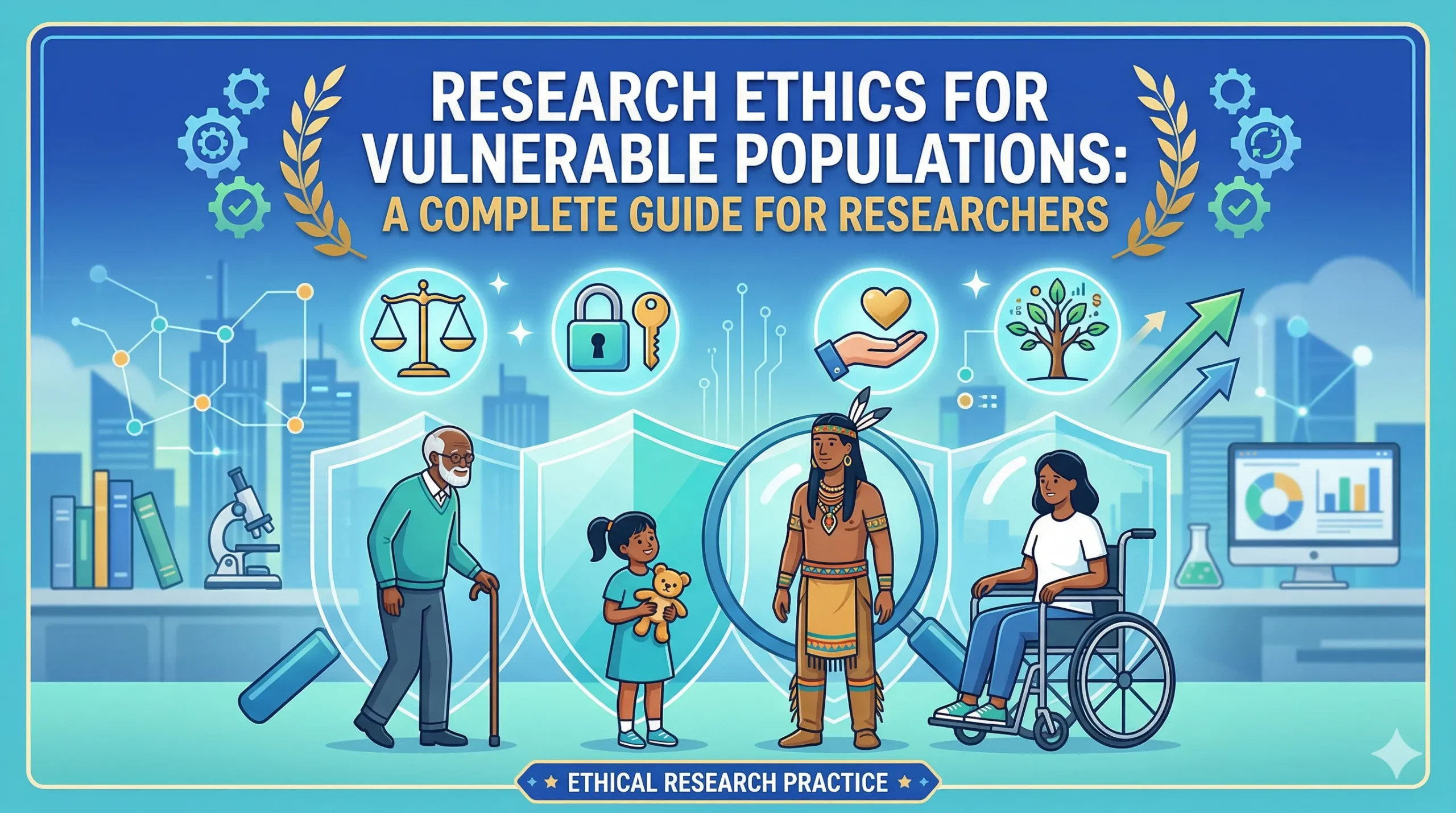
The history of human subjects research includes some of the most serious Research Ethics violations in the history of science. In each of these cases, researchers inflicted harm on people who lacked the power, autonomy, or information to protect themselves, including the Nazi medical experiments, the Tuskegee Syphilis Study, the Guatemala syphilis experiments, and the Willowbrook hepatitis studies. These abuses led directly to the international ethical frameworks that govern research today.
Vulnerability in research is not a fixed attribute of a person, it is a relationship between a person, their circumstances, and the research context. Someone who is highly autonomous in their daily life may become vulnerable when hospitalized, incarcerated, or economically dependent on the institution conducting the research. A 2025 systematic review of policy documents across 79 guidelines found that while most research ethics frameworks identify vulnerable groups, fewer than 13% of documents explicitly define what vulnerability means, leaving significant ambiguity for researchers in practice.
This guide provides a practical, comprehensive framework for identifying vulnerable populations in your research, understanding the ethical requirements that apply, designing appropriate protections, and meeting the publication standards that journals and ethics boards now expect.
| Foundational Principle The Belmont Report’s three core principles. Respect for Persons, Beneficence, and Justice, apply with heightened force when research involves vulnerable populations. Respect for Persons requires additional safeguards when individuals have limited capacity to provide voluntary informed consent. Beneficence demands that risks to vulnerable participants be minimized and explicitly justified. Justice requires that vulnerable populations are not unfairly burdened with research risks while being excluded from its benefits. |
Defining Vulnerability in Research: The Spectrum Approach
Traditional ethics frameworks took a categorical approach to vulnerability identifying specific groups (children, prisoners, pregnant women) as vulnerable and applying blanket additional protections to all members of those groups. Contemporary ethical thinking has moved toward a contextual, spectrum-based understanding that is more nuanced and more useful in practice.
Vulnerability is not all or none. A person is more or less vulnerable depending on the specific research context, the nature of the risks involved, and their individual circumstances. The same individual may be minimally vulnerable in one study and highly vulnerable in another. This contextual understanding has three important implications for research design:
- Do not automatically exclude: Excluding individuals from research solely because they belong to a traditionally vulnerable group is itself unethical. It perpetuates research inequities and means that findings may not apply to the populations who most need them. The principle of nothing about me without me demands inclusive approaches.
- Do not automatically include without safeguards: Including vulnerable participants without additional protections constitutes exploitation. The challenge is to include appropriately, with rigorous safeguards in place.
- Assess vulnerability case by case: Evaluate each research protocol for the specific vulnerabilities it may create or encounter, and design your protections around those specific vulnerabilities rather than applying generic category-based rules.
Who Counts as Vulnerable? A Comprehensive Reference Table
| Vulnerable Group | Primary Source of Vulnerability | Key Additional Protections Required |
| Children (under 18) | Limited decision-making capacity; developmental stage | Parental/guardian consent + child assent; age-appropriate language; lower risk threshold |
| Prisoners and incarcerated individuals | Coercive environment; limited autonomy | Research must primarily benefit prisoners; IRB subcommittee review in US |
| Pregnant women and fetuses | Dual risk to mother and fetus; potential coercion | Federal subpart B regulations (US); fetal risk must be minimized independently |
| People with cognitive impairments | Reduced capacity to provide voluntary informed consent | Capacity assessment; legally authorized representative consent; ongoing monitoring |
| Individuals with mental illness | Variable capacity; potential power imbalance with clinicians | Fluctuating capacity protocols; trauma-informed procedures |
| People in poverty or low-income settings | Susceptibility to undue influence from incentives | Reasonable (not excessive) compensation; avoid coercive enrollment |
| Undocumented individuals and refugees | Fear of legal consequences; distrust of institutions | Enhanced confidentiality protections; no data linkage to government systems |
| Terminally ill patients | Desperation for treatment; reduced alternatives | Direct benefit requirement; careful risk-benefit analysis |
| Employees and students | Power dynamics with researcher in authority role | Explicit voluntary participation; no consequences for refusal; anonymous response where possible |
The Two Core Sources of Vulnerability
The National Bioethics Advisory Commission (NBAC) identified two primary mechanisms through which vulnerability arises in research. Understanding these helps you design protections that address the actual source of risk rather than applying surface-level compliance measures.
1. Impaired Capacity for Voluntary Informed Consent
Some individuals cannot fully understand what research participation involves due to age, cognitive impairment, serious mental illness, language barriers, or intoxication. When capacity is impaired, the standard informed consent process does not provide sufficient protection because you cannot assume comprehension.
Protections for capacity-related vulnerability include:
- Formal capacity assessment tools before enrollment for populations with variable cognitive function
- Legally authorized representative (LAR) consent, where required by regulation and ethics board policy
- You should seek and respect the participant’s willingness to take part, even when a representative provides formal consent.
- Simplified consent documents written at an appropriate reading level (aim for grade 6–8 reading level for general populations)
- Iterative consent processes, checking comprehension and willingness to continue at multiple points during longer studies
2. Susceptibility to Coercion or Undue Influence
Even individuals with full decision-making capacity may be vulnerable if their circumstances create pressure to participate that compromises voluntary choice. Coercion involves a direct threat. Undue influence involves an offer so attractive, relative to the individual’s circumstances that it overrides rational evaluation of the risks.
Common sources of coercive vulnerability include:
- Institutional authority: students recruited by their professors, patients recruited by their treating physicians, employees recruited by their managers
- Economic desperation: participants in poverty who enroll primarily because of financial compensation that seems substantial relative to their circumstances
- Incarceration creates a vulnerable context because prisoners may perceive research participation as offering benefits such as better conditions or favorable review, and federal regulations explicitly prohibit using such benefits as inducements.
- Dependency on the research institution: patients receiving care at the institution conducting the research may fear that refusing participation will affect the quality of their treatment
Designing Ethical Research With Vulnerable Populations: 8 Principles
- Justify inclusion explicitly: In your ethics application and your manuscript, explain why vulnerable participants are necessary to address your research question.If you can answer the same question using a less vulnerable population, you should choose that approach instead.
- Minimize risk proactively: Conduct a systematic risk-benefit analysis from the perspective of the vulnerable participants themselves, not just the general population. A risk that is acceptable for a healthy adult may be unacceptable for a child or a person with a serious illness.
- Design consent processes for the population: Standard consent forms are rarely adequate for vulnerable populations. Develop consent materials that are accessible in terms of language, literacy, and format for your specific participant group.
- Separate recruitment from care: Where possible, the clinician providing care and the researcher recruiting participants should be different people. If this is not possible, explicitly address the potential therapeutic misconception, the tendency of patients to conflate research participation with clinical treatment.
- Offer reasonable, not excessive, compensation: Compensation should reimburse participants for time, travel, and inconvenience without being so large that it constitutes undue inducement. Your IRB will review this, but you should apply the principle proactively in your study design.
- Protect confidentiality with enhanced rigor: For populations where identification could cause direct harm to undocumented individuals, people with stigmatized health conditions, incarcerated people implement the strongest available data protection measures. Consider whether data should be collected at all if secure storage cannot be guaranteed.
- Build in ongoing monitoring: Vulnerability can change during a study. You should set clear procedures for withdrawing participants if their circumstances change, if the research becomes more distressing than expected, or if new information shows that you underestimated the risks.
- Engage communities, not just individuals: Researchers increasingly use community-based participatory approaches when working with indigenous populations, marginalized communities, and other groups that have historical reasons to distrust research institutions. These approaches involve community members in study design, implementation, and interpretation, and ethics boards and high-impact journals now expect them.
What IRBs and Ethics Boards Specifically Require?
When you involve vulnerable populations in your research, you almost always need an ethics review, and review boards typically conduct it at the expedited or full board level rather than grant an exemption.
Reviewers will specifically assess:
- Whether the inclusion of vulnerable participants is scientifically necessary and appropriately justified
- Whether the risk-benefit ratio is acceptable given the increased vulnerability of the population
- Whether consent procedures are appropriately modified and adequate for the population
- Whether additional monitoring or oversight is built into the protocol
- Whether the researcher and team have appropriate training and experience with the population
In the United States, certain vulnerable populations trigger specific regulatory subparts under the Common Rule (45 CFR 46). Subpart B governs pregnant, human fetuses, and neonates. The Subpart C governs prisoners. Subpart D governs children. Research involving these populations under federal oversight must comply with the specific requirements of the applicable subpart, in addition to the general IRB requirements.
How to Write Ethics Statements for Manuscripts Involving Vulnerable Populations?
Journals increasingly require detailed ethics statements, and manuscripts involving vulnerable populations receive closer scrutiny during peer review. Your methods section should explicitly address:
- The specific vulnerable population included and the justification for their inclusion
- The name of the ethics board that reviewed and approved the study, and the approval reference number
- The specific consent procedures used, including any modifications to standard consent processes
- How participant capacity was assessed where relevant
- What protections were implemented against coercion or undue influence
- Any monitoring or safeguarding procedures that were active during data collection
Failing to provide this level of detail for research involving vulnerable populations is an increasingly common reason for journal rejection or major revision requests. Editors and reviewers treat it as a signal of either ethical shortcuts or insufficient methodological training.
Conclusion
Research with vulnerable populations is among the most ethically complex work a researcher can undertake, and among the most important. The findings generated from appropriately conducted research with children, older people, people with disabilities, and other vulnerable groups are essential for developing interventions, policies, and treatments that actually serve the people who need them most.
Getting the ethics right is not just about regulatory compliance. It is about the fundamental obligation of researchers to the people who trust them with their time, data, and in some cases their safety. With the right protections, consent processes, and oversight, you can conduct research with vulnerable populations with full scientific integrity and genuine respect for participants.
If you are preparing a manuscript involving vulnerable populations and need support with your methods section, ethics statement, or journal submission, Mars Publications offers expert guidance for exactly these complex cases.
| Ready to Submit Your Research for Publication? Mars Publications provides expert manuscript editing, ethics statement preparation, and Scopus journal submission support for researchers conducting sensitive and complex human subjects research. Explore Resubmission & Submission Support: Resubmission Support |