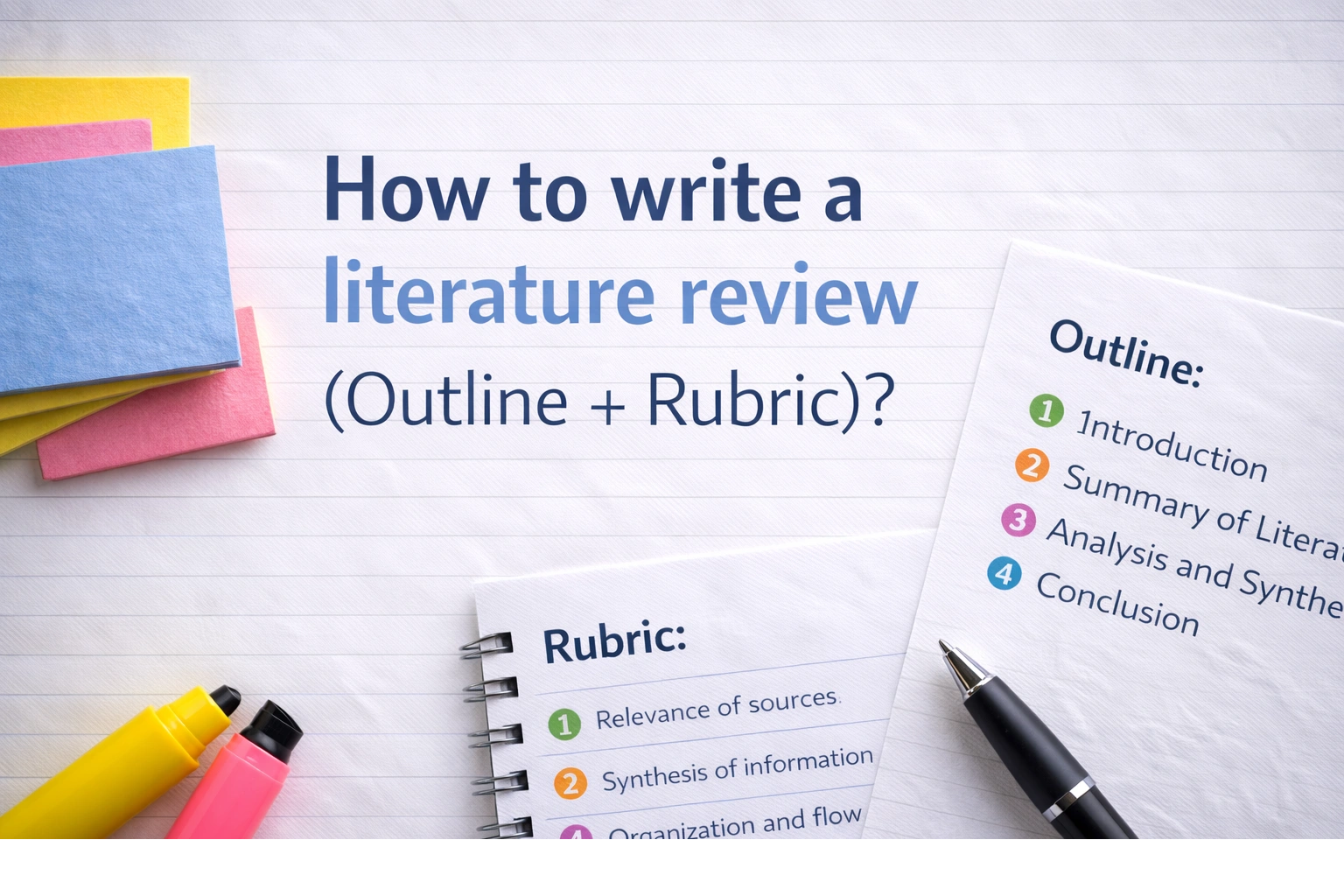
Literature review is not merely a summary of papers, but it is a compilation of the available literature, trends, identification of inconsistencies and where your work fits in the line of scholarly discussion.
Numerous researchers find it hard to do more than simple summarisation. This rubric presents you with a practical guide that you can consider in any discipline and a rubric that you can use to assess your output. By obeying these structural rules, you will match your Research Paper Writing to the publication guidelines of academic publishing.
Before You Start, Establish the Scope and Strategy
- Guide your subject and make two or Three Review Questions: An objective analysis begins with articulate questions. Most questions: Do not ask to see everything about climate policy, but instead: How have carbon-pricing research assessed economic effects in Europe since 2010? Or what qualitative approaches prevail in community adaptation to coastal flooding? Closure frames narrow questions contribute to the prevention of scope creep.
- Design a Search Plan, which You Can describe: Select databases that align with your discipline, such as Scopus, Web of Science, PubMed, JSTOR, or discipline-specific archives. List your keyword combinations and Boolean strings. Record the number of hits at each stage and the clipping down of the search. This transparency will help the methods section later.
- Early Select Inclusion and Exclusion Criteria: Define what counts. Choose how many of the peer-reviewed empirical studies, or even theoretical papers and book chapters, you want to include. Determine the years, the language boundaries, etc. It has clear criteria that render the review reproducible and defensible.
Outline of Literature Review You Can Reuse
- Introduction: Subject, Significance, and Thesis: Explain the reasons the topic is important, define important terms, and describe the frame you are working in, the theoretical, methodological, or chronological frame. At the end, the reader must understand what the review is about and why it is important.
- Methods of Searching: Concisely explain your search location and selection of sources. Add database names, the data of search and the quantity of records reviewed and eventually included. There is still a short part, which demonstrates rigour.
- Thematic Synthesis: Arrange the review into three or five themes that arose out of the literature. In every theme, compare writers, demonstrate concurrence and disagreement, and identify trends in time or in the method. Such a synthesis, as opposed to a list of summaries, is the blood of strong research writing.
- Theoretical or Conceptual Framework: Explain the paradigmatic or theory-based research in your field. Demonstrate the relation of various studies to these frameworks. This shows that you understand the intellectual basis of your field.

Patterns and Signals of Methodology
Gap Statement and how your study fills this gap
Articulate a specific gap. Do not make a generic statement such as, more research is needed. Rather, state the lost population, setting, procedure or result. Then connect the gap to the objectives of your study.
How To Synthesise, Not Summarise?
Compare and Contrast Sentences.
Write sentences which place studies in dialogue, e.g. Whereas Ahmed reports powerful effects in cities, the rural data reported by Chen reveal no significant effect, which may be due to less intensity of intervention. Such a structure indicates that you know about relationships, not plain results.
Apply Evidence Mapping as a Rapid Method.
Prepare a table in your note: author, year, method, sample, key findings, limitations. The map allows you to see patterns without having to read through each source each time.
Avoid These Common Traps
Do not turn your review into an annotated bibliography that summarises a study in a paragraph. Do not overquote; simply paraphrase. Keep your argument thread; all the paragraphs must be to the general end. Generalisation and lucidity prefer realism to a tiresome, diffuse description.
- Literature Review Rubric: A checklist to self-grade your literature review.
- Structure and Flow: Are the sections of the review clear? Are the themes in a logical sequence? Are transitions smooth? A properly organised review is nothing like a random pile of notes, but a literary form of an argument.
- Source Quality and Coverage: Have you reconciled recent research on the same with the old centuries old? Are Divine sources credible and relevant? Is it representative of the diversity of the field, or is it excessively focused on a single point of view?
- Synthesis and Critical Insight: Do you compare studies with each other? Why are there differences in findings? Have you established real patterns and gaps, or simply outlined what the individual authors have said? This criterion distinguishes between descriptive and analytically useful reviews.
- Academic Writing Quality: Is your language accurate and regular? Does it include citations that are properly structured? Have you cut out repetition and wordiness? This rubric indicates excellent standards of research writing.
Conclusion
Establish scope and search strategy. Classify group sources into themes. Compose synthesis in compare-contrast sentences in each thematic segment. Use the rubric on your draft, improve, and the question is, does the review give a clear narrative of what is known and what needs to be done?
Adherence to such a workflow makes the literature review meet the requirements of academic publishers and reviewers. These principles are applicable regardless of whether you are writing a thesis chapter, a journal article introduction or a standalone review. The initial work on time will pay later with less confusion on the writing, better lines of argument, and less revision. Contact Mars Publications now if you need a research submission without any delays.