You have to complete a manuscript, a deadline on a grant, or you have to refine a study design. The expertise that you need can be provided by a research consultant, and only one whom you select.
An effective consultant introduces clarity, rigour, and moral support. A low spec specifies on time, compromises information, or claims to do things that it can not do. This guide will provide you with a hiring checklist, some critical questions to ask, and red-flag warning signs. Being aware of these differences can guide you through the publication-centred workflow, Mars Publications proclaims.
How To Organise a Secure Contract and Workflow?
Put everything in writing. Stipulate work scope, schedule, number of revision cycles and payment frequency. Add confidentiality, data management and ownership of intellectual property clauses. Indicate precisely what Journal Submission Services are included in the event that this is a part of the engagement.
A clear contract and keeping both sides and keeping you to what you pay. It also proves that the consultant works professionally and anticipates accountability.
What a Research Consultant Can and Can’t Do?
- Legitimate Support Areas: A competent consultant assists with study design, process instructions, direction in data analysis, and report clarity. They recommend journal fit, revision strategies and peer feedback navigation. They demonstrate to you the way on how to reinforce your work and leave final decisions and authorship to you. Professional journal-submission support is so when it is related to formatting, compliance and submission-readiness rather than guaranteed results.
- What Crosses the Line? No honest consultant would guarantee acceptance, or offer to influence editors, or come up with fabricated data or modify it. Purchasing authorship, creating bogus peer review, or purporting to have secret links to journal offices are obvious breaches of research integrity. Never trust a person who wants to make some ethical compromises or wants your data to say something it is not.
Just in Time Before You Search: Define What You Need
- Clarify Your Deliverable: Do you require assistance in writing a protocol, cleaning a dataset, interpreting statistical output, or polishing a manuscript to submit? Various consultants have different stages. Be clear on what you want to see at the end of the engagement. In case of journal-submission support, specify whether this includes format, cover-letter preparation or submission-portal preparation.
- List Your Constraints: When you begin interviewing, know your timeline as well as your budget, availability of your data and your ethics approval status. A well-performing consultant in the context of 6 months would not fit in three weeks. When you know these parameters, you can locate somebody who is available and works the way you do.
- Understand Your Success Criteria: What does success look like? A clearer analysis plan? Manuscript in journal format? A resubmission plan which will address the reviewer’s remarks? Quantifiable results are used to assess whether the engagement brought value.
The Hiring Checklist: What to check
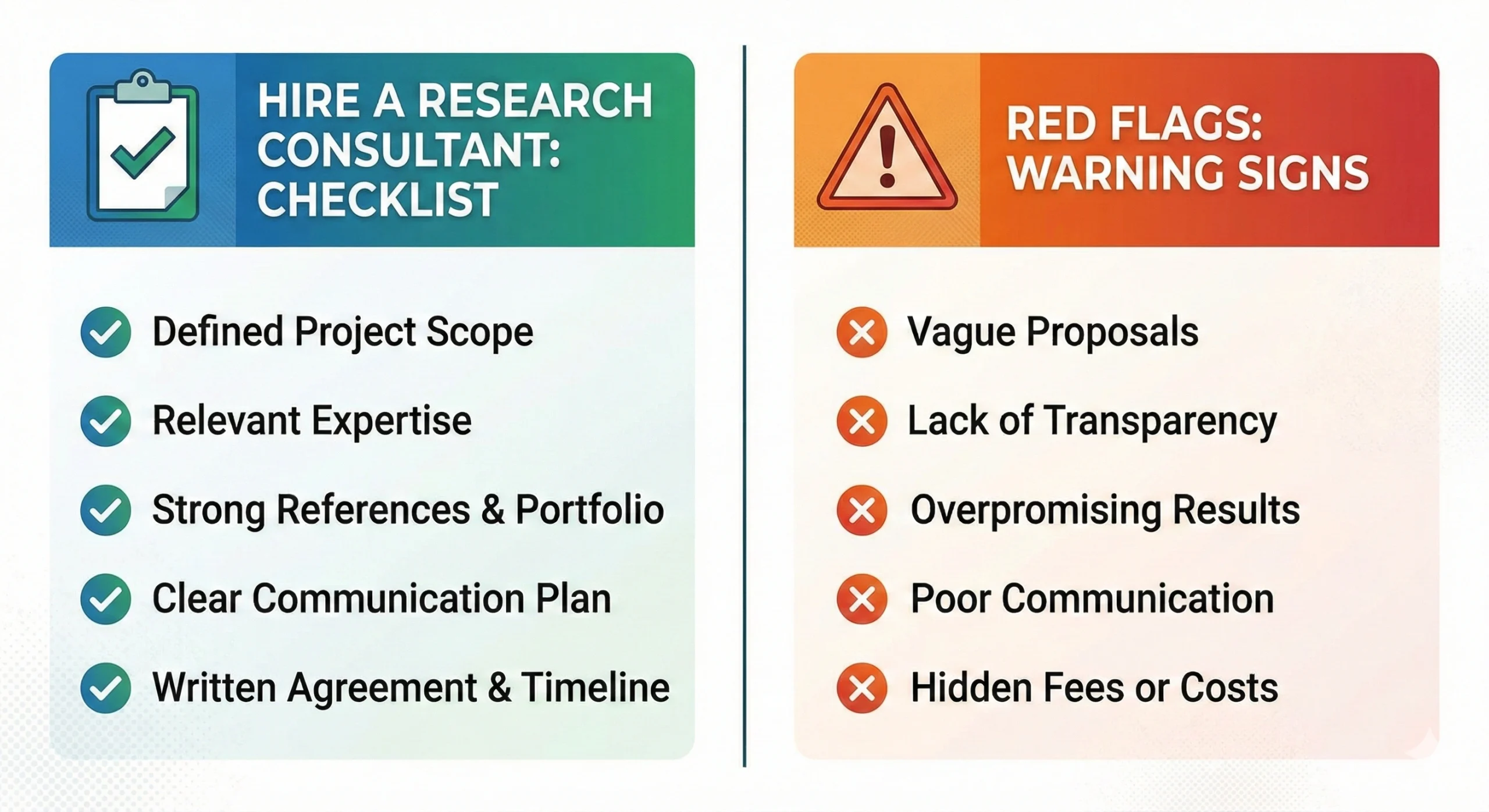
- Signs of Specialism and Applicability: Review their past work. Have they been in your field? Are their approaches relevant to your research question? Ask about their publication history, ORCID record and Google Scholar account, where possible. Any consultant who fails to demonstrate any relevant experience is beginning anew with your project.
- Process Clarity: The Way They Work with You: Ask about their workflow. Do they begin with a kick-off meeting? Are they drafting something so that you can read it? What is their version control and feedback? Obvious responses will show a professional who upholds your position as the head researcher.
- Ethics and Compliance Alignment: Talk about their policies on plagiarism, AI application, and data integrity. Make sure that you clarify authorship expectations at the beginning. A consultant willing to conceal AI input or conceal methodological decisions is not serving your best interests.
- Basics of Data Privacy and Security: Inquire about the provision of nondisclosure agreements. Enterprise controls, data storage, and data deletion. Completely understand who has access to your dataset and on what basis. These protections are important regardless of whether you work with or not.
- Turnaround Standards and Communication: Determine anticipated response time, reaction pace and the mechanism of managing change requests. Get clear on what is in and out of scope, as well as what is going to attract extra charges. The editorial-style checkpoints which Mars Publications puts an emphasis on in their guidelines rely on effective communication among all people.
Interview Questions to Ask
- Approaches and Decision-Making Queries: Inquire about the choice of statistical tests or methods of analysis. Ask them about assumption management, sensitivity checks and reporting guidelines. Better responses are those with methodological depth, not prescriptions.
- Publication‑Readiness Questions: Enquire about their organisation of the Results and Methods sections. Ask about their attitude to tables, figures and to reporting standards such as CONSORT or PRISMA. The essential added value is the consultant who knows the specifics of journals.
- Submission Support Questionnaires: To be sure of the services available to aid your journal submission, you need to know what journal-submission services entail and do not entail. Does it include formatting, letters of cover, and preparation of supplemental material? But will they deal with the portal upload or take you through it? Easy scope eliminates confusion in the future.
Red Flags You Need to Open Your Eyes To
- Guarantee Language and Faulty Timelines: No consultant is able to guarantee that there is acceptance. Anybody offering a 100% publication guarantee, a seven-day decision, or special access to editors is defrauding you. The workflow, which is reputable, such as that which Mars Publications promotes, does not include guarantees.
- Refusal to Show Process or Give Scope in Writing: In case a consultant fails to articulate their process or declines to put the scope in writing, leave. Lack of specific deliverables, ambiguous revision policies, and lack of milestone plans cause a conflict in cases where expectations differ.
- Authorship and Integrity Issues: Invitations to invite authors, manipulate data, conceal the use of AI or circumvent ethics review go against research integrity. One red flag in this category means that the conversation is over.
Conclusion
Select the advisor with a clear process, ethical lines, and manifestation of field-fit competence. Shun anybody who promises what any honest professional would not promise.
Publishing better, not faster, at the cost of integrity is done by the right consultant. They sharpen your intellect, build your approaches and help in your achievement without leaving you roaming your work. That relationship of trust and understanding of expectations is worthwhile, long after one project is completed.