
Having a research paper or a journal indexed in Scopus is an academic publishing milestone. Scopus, owned by Elsevier, is one of the world’s largest and most reliable abstract and citation databases. Scopus indexing for researchers translates to increased visibility, better citations, and enhanced credibility. For journals, it is proof of editorial and publishing quality.
But Scopus indexing is not an easy task. The database is very strict, and even a minor mistake in formatting, metadata, or compliance can result in rejection or postponement. That’s why most authors and publishers seek professional Advanced Formatting Services to guarantee their submissions conform with the precise specifications of Scopus.
In this blog, we’ll show you step by step how to submit for Scopus indexing, pitfalls to watch out for, and how to ensure your success.
Why Scopus Indexing Is Important?
Before we get into the process, it’s helpful to know why Scopus indexing is so beneficial:
Global Recognition: Papers in Scopus are made available to an international academic community.
Increased Citations: Indexing improves the likelihood of other researchers reading and citing your work.
Academic Recognition: Research quality is often measured by Scopus-indexed journals by promotion committees, funding bodies, and universities.
Impact Measurement: Scopus offers metrics such as author profiles, citation numbers, and h-index that improve scholarly careers.
Without Scopus indexing, even quality research could go underread and uncited.
Who is eligible to apply for Scopus Indexing?
Scopus indexing can be applied for:
Journals: Editorial boards or academic publishers can submit an application to have their journal indexed in Scopus.
Conference Proceedings: Academic conferences with published proceedings can also apply.
Book Series: Some scholarly book series are eligible for indexing.
Important: Individual researchers cannot apply to get a single article indexed in Scopus. Instead, their articles must be published in a Scopus-indexed journal.
Step-by-Step Process to Apply for Scopus Indexing
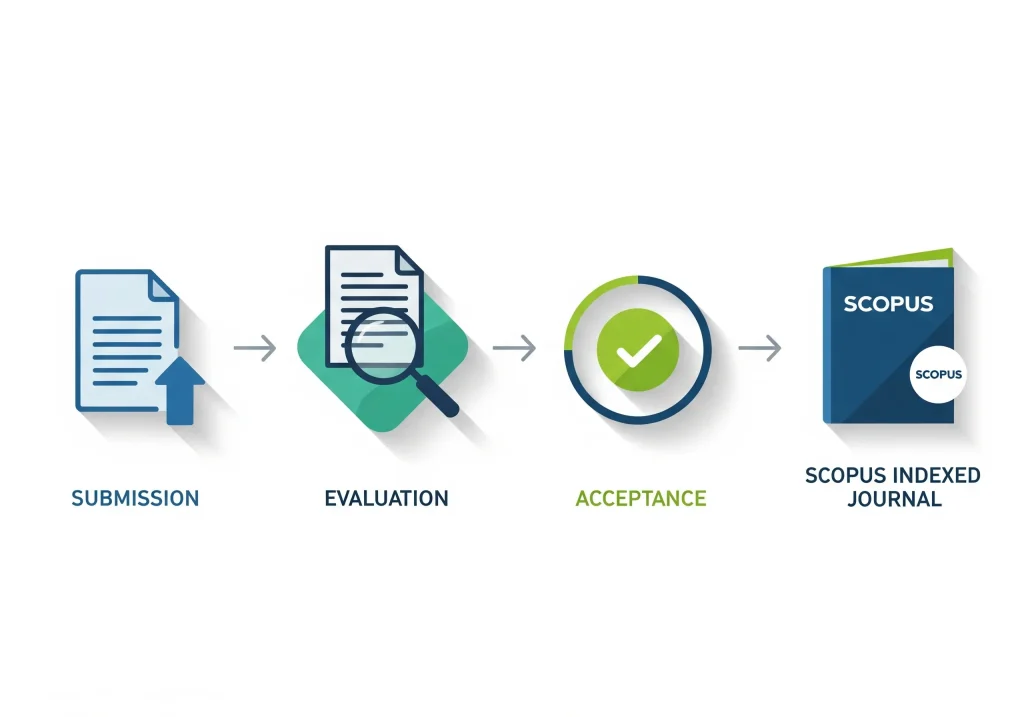
Here’s a breakdown of the application process:
1. Verify Eligibility
Before applying, confirm that your journal or publication meets the basic requirements:
Regular publishing schedule.
ISSN registration.
A functional website with open archives.
Clear peer-review procedures.
Diversity at the international level in editorial board and authors.
2. Compile Necessary Information
Scopus asks for comprehensive information in the application, including:
Journal title, ISSN, and publisher.
Editorial board information (names, affiliations, countries).
Peer-review procedure and flow.
Author demographics (preferably with international representation).
Publication ethics statement.
3. Apply Using the Scopus Title Evaluation Platform (STEP)
Applications are made online using the Scopus Title Evaluation Platform (STEP).
Publishers or journal managers should sign up and enter all necessary metadata.
4. CSAB Evaluation
Applications are then evaluated by Scopus’s Content Selection & Advisory Board after they have been submitted, considering aspects such as:
Journal quality and scope.
Editorial board diversity and expertise.
Adherence to publishing ethics.
Citation metrics (for existing journals).
5. Receive Decision
Upon approval, the journal will be indexed in Scopus and articles will eventually appear in the database.
If rejected, Scopus usually gives feedback, and journals can resubmit once the issues have been resolved.
Common Reasons Scopus Applications Are Rejected
- Most potential journals fall at the indexing level due to preventable errors. Here are some of the most frequent traps:
- Weak Metadata and Poor Formatting.
- Incorrect author names, affiliations, or lack of ORCID IDs.
- Poorly formatted references without DOIs.
- Titles and abstracts that do not match indexing requirements.
- Limited International Perspective.
- Editorial boards or authors all from a single country.
- Lack of international readership attraction.
- Unclear Peer-Review Policy
- Journals need to provide evidence of an open and rigorous review process.
- Poor Website Functionality
- Ineffective journal websites, dead links, or archive gaps.
- Ethical Oversights
- Lack of conflict of interest statements or plagiarism policy.
How To increase your approval prospects, follow these tips:
1. Improve Journal Metadata
Employ consistent author names and provide ORCID IDs.
Provide proper affiliations with complete institution information.
Ensure abstracts are organized, brief, and keyword-heavy.
2. Streamline References and Citations
Utilize reference management tools such as EndNote or Mendeley.
Ensure DOIs for all references.
Conform to the required citation style uniformly.
3. Facilitate Global Representation
Ensure the editorial board has members from several regions.
Foster international authorship for global applicability.
4. Ensure Peer Review Transparency
Publish transparent guidelines for peer reviewers.
Make review policies and schedules available on the journal website.
5. Invest in Website and Online Infrastructure
Develop a professional, accessible journal website.
Make archives, submission instructions, and ethics policies available.
Role of Advanced Formatting Services in Scopus Applications

Technical formatting is one of the most underappreciated elements of Scopus applications. Even top-tier journals are at risk of being rejected if metadata and manuscripts fail to comply with Scopus’s rigorous standards.
Advanced Formatting Services are where this becomes a necessity. At Mars Publications, we assist journals and writers by:
Metadata Optimisation: Maintaining title, abstract, and keyword compliance with indexing requirements.
Author Standardization: Standardizing names, affiliations, and ORCID integration.
Reference Accuracy: Citation correction, DOI verification, and consistency checks.
Journal Compliance Checks: Website reviews, ethics policies, and peer-review transparency checks.
Database-Specific Formatting: Preparing submissions according to Scopus’s specific needs.
Through removing technical flaws, we enable journals and publishers to submit a refined application that has the highest chances of success.
FAQs on Scopus Indexing
1. How long does the Scopus application process take?
The process of review may take 6–12 months based on the number of applications received and the journal’s preparedness.
2. Can a single author submit for Scopus coverage?
No. Only books, conference proceedings, and journal series can submit. Authors need to publish in Scopus-listed journals.
3. What are the primary evaluation factors of Scopus?
Journal quality, peer-review quality, international participation, ethical publishing behavior, and technical conformity.
4. Are all Scopus submissions accepted?
No. Scopus has a strict selection process, and a lot of applications are turned down because of poor policies, bad formatting, or insufficiently international content.
5. How can Mars Publications assist Scopus applications?
With Advanced Formatting Services from Mars Publications, we assist journals in conforming to Scopus standards, fix technical problems, and enhance presentation overall.
Conclusion
Submiting for Scopus indexing is a technical but highly gratifying process. It takes more than good content, it takes technical accuracy, global standards, and perfect formatting.
With a clear idea of the requirements and a knowledge of pitfalls to avoid, journals and publishers can greatly enhance their prospects of acceptance. With the expert assistance, particularly through professional Advanced Formatting Services, their application will be distinguished and up to academic publishing standards.
At Mars Publications, we make sure your submission is scientifically rigorous as well as technically optimised for Scopus. Allow experienced professionals to avoid costly mistakes and drive your research towards success.