
You have a research idea. You want to collect data from people. The question hits you: Do I need IRB approval for this?
The answer is not always obvious and getting it wrong carries real consequences. Submitting without ethics approval when it was required can lead to journal rejection, institutional sanctions, or retraction of published work. Assuming you need full board review when you are actually exempt can delay your project for months unnecessarily.
This guide gives you a clear, structured answer. It covers what the IRB actually is, which projects require review, the three categories of review, and the specific cases where no IRB approval is needed at all.
| Key Principle The golden rule: if your work involves a systematic investigation designed to contribute to generalizable knowledge AND involves living human subjects, IRB review is almost certainly required. But the level of review exempt, expedited, or full board depends on the risk involved. |
What Is an Institutional Review Board (IRB)?
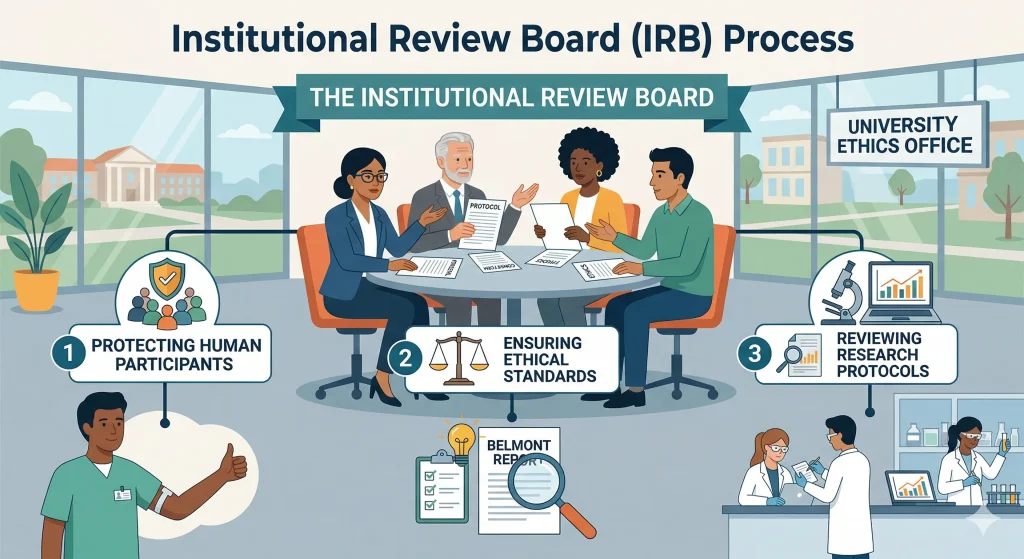
An Institutional Review Board (IRB) also called an Independent Ethics Committee (IEC), Research Ethics Board (REB), or Ethical Review Board (ERB) depending on your country; is a formally designated committee that reviews research involving human participants to ensure it meets ethical standards.
IRBs were established following a series of research abuses throughout the twentieth century, most notably documented in the Nuremberg Code (1947) and codified in response to the Tuskegee Syphilis Study through the National Research Act of 1974 and the resulting Belmont Report (1979). The Belmont Report established three foundational ethical principles that still govern human subjects research today:
- Respect for Persons: Participants must be treated with autonomy. Informed, voluntary consent is required.
- Beneficence: Research must maximize benefits and minimize harms. Do no harm.
- Justice: The risks and benefits of research must be distributed fairly across participant populations.
In the United States, IRBs are governed by 45 CFR Part 46 (the Common Rule) and, for FDA-regulated research, by 21 CFR Parts 50 and 56. More than 130 countries have equivalent review bodies. Most academic journals now require evidence of IRB approval or an institutional ethics statement for any human subjects research, regardless of whether it is legally mandated in your country.
The Core Question: Is Your Work “Research” Under the Regulatory Definition?
Not everything involving people requires IRB review. Under the Common Rule, “research” has a precise definition:
| Legal Definition of Research (45 CFR 46) “A systematic investigation, including research development, testing, and evaluation, designed to develop or contribute to generalizable knowledge.” |
Both conditions must be met: it must be systematic AND designed to produce generalizable knowledge (i.e., findings you intend to apply beyond the specific context or publish for broader use).
Activities That Are NOT Research and Do NOT Need IRB Review
- Quality assurance and quality improvement projects where the intent is to assess or improve an organization’s own programs or services
- Oral history or journalistic work limited to documenting events without drawing generalizable conclusions about populations
- Class projects where the primary purpose is teaching research methods, not contributing to publishable knowledge
- Routine program evaluation assessing whether a specific program meets its goals within one organization
- Case reports, clinical descriptions of one or two patients, where no systematic data collection is designed
Important exception: if you later decide to publish findings from a quality improvement project or class project in a peer-reviewed journal, most journals will require you to have obtained IRB approval or exemption before you collected the data. The decision to pursue IRB review should be made at the design stage, not after the fact.
The Three Levels of IRB Review
If your project is research involving human subjects, it falls into one of three review categories. Only the IRB, not the researcher can determine which category applies.
| Review Type | Risk Level | Typical Projects | IRB Involvement |
| Exempt | Minimal / No risk | Anonymous surveys, educational tests, existing public datasets | IRB determines exempt status, researcher cannot self-declare |
| Expedited | Minimal risk, some identifiable data | Online interviews, focus groups with adults, non-sensitive health surveys | Reviewed by 1–2 IRB members (not full board) |
| Full Board | Greater than minimal risk | Vulnerable populations, clinical trials, deception studies, sensitive topics | Full committee review required; meets on schedule |
| Not Research | N/A | Quality improvement, journalism, oral history, class projects | No IRB required if not contributing to generalizable knowledge |
1. Exempt Research
Exempt research involves minimal risk and falls under one of the specific categories defined in the Common Rule (45 CFR 46.104). Despite the name, “exempt” does not mean no review, it means the project is exempted from certain continuing oversight requirements. The IRB still makes the determination of exempt status; you cannot declare your own research exempt.
Common examples of exempt research include surveys and interviews with adults where: the responses are recorded anonymously, disclosure cannot place the subject at risk, and no sensitive topics are involved. Secondary analysis of existing publicly available datasets also typically qualifies.
2. Expedited Review
Expedited review applies when the research presents no more than minimal risk to participants and fits within one of the specific expedited categories listed in federal regulations. Rather than going to the full board, the research is reviewed by one or two designated IRB members. Common expedited projects include online interviews with adults on non-sensitive topics, non-invasive biospecimen collection, and research involving existing records or data.
3. Full Board Review
Full board review is required when research involves more than minimal risk, includes vulnerable populations (children, prisoners, pregnant, or individuals with cognitive impairments), or involves deception. The full committee must convene and vote. This is the most time-intensive category, and proposals must be submitted well in advance of the board meeting schedule.
Special Cases That Researchers Frequently Misunderstand
Online Surveys and Anonymous Data
Many researchers assume that because an online survey is anonymous, it is automatically exempt. This is not correct. The IRB must still review it to confirm exempt status. Additionally, “anonymous” has a specific technical meaning if your survey platform collects IP addresses or you can link responses to individuals through any means, the data may not be fully anonymous.
Secondary Data Analysis
Using existing datasets such as hospital records, government data, or previously collected survey data often qualifies for expedited or exempt review if the data was already anonymized before you accessed it. However, if the data contains identifiable information (even coded identifiers) and was not originally collected for research, you still need to determine whether IRB review is required.
International Research
If your research is conducted in another country, you may need ethics approval from both your home institution and the local ethics board in the country where data is collected. Many funders and journals require this dual approval. The Common Rule also applies to US-funded research conducted abroad.
Does Publishing Trigger IRB Requirements?
A persistent myth is that IRB review is required only if you publish. This is false in both directions: you may need IRB review for non-published systematic investigations, and simply publishing findings from a quality improvement project does not retroactively make it “research” under the regulatory definition. However, most peer-reviewed journals require evidence of ethics review regardless of legal requirements, making practical ethics compliance a publication necessity.
Practical Steps: How to Determine Whether You Need IRB Review?
- Step 1: Ask whether your project is a “systematic investigation designed to contribute to generalizable knowledge.” If yes, proceed to Step 2.
- Step 2: Confirm whether your project involves living human subjects directly or through identifiable data about them.
- Step 3: Submit a pre-review inquiry to your institution’s IRB. Most allow you to describe your study and ask whether review is required before submitting a formal proposal.
- Step 4: If review is required, determine whether exempt, expedited, or full board review applies based on risk level and population type.
- Step 5: Do not begin data collection until you have written confirmation of IRB approval or exempt status. Starting early can result in the data being unusable for publication.
What Journals Require?
Regardless of whether IRB review is legally required in your country, most Scopus-indexed and Web of Science journals require either: (a) a statement confirming IRB or ethics committee approval, or (b) a clear explanation of why review was not required (e.g., all data were publicly available and non-identifiable).
Journals such as those published by Elsevier, Springer, Wiley, and most open-access platforms now have ethics checklists that authors must complete at submission. Failing to address these requirements is an increasingly common cause of desk rejection.
When your manuscript includes human subjects research, include the following in your methods section: the name of the approving ethics board, the approval or reference number, and the date of approval. For projects that did not require formal review, a brief statement explaining why is usually sufficient.
Conclusion
Ethics review and IRB approval are not bureaucratic obstacle. They are the foundation of trustworthy, publishable research. The key is understanding exactly which level of review your project requires, and initiating that process before any data collection begins.
If you are preparing a manuscript that involves human subjects research and need help ensuring your methods section and ethics statement meet journal requirements, Mars Publications offers comprehensive manuscript editing and journal submission support to help your research reach the right audience.
| Ready to Submit Your Research? Mars Publications provides expert support for Scopus and ISI journal submissions including manuscript editing, ethics statement preparation, and journal selection. Explore Scopus Journal Support: Scopus Indexed Journal Support |