Suppose a pair of scientists is examining government trust in voters. One surveys a thousand individuals this month reports that the level of trust is related to age and news consumption. The other tracks the same voters over five years and concludes that there is a loss of trust that is recovered gradually during legislative years following elections.
Both studies are valid. They respond to various questions. The former gives a reflection of the existing associations. The second exposes the dynamics of the change in trust and the predictors of changes. Knowing this difference is relevant in all fields of study, be it political science, public health or education.
This guide takes a tour of the definitions of two designs, their use cases, and reporting expectations. It uses the publication-type of focus that Mars Publications puts into the limelight and that fall within the methodology guideline typical of Wiley and other academic giant publishers.
Definitions That Really Count
Cross‑Sectional = A Snapshot
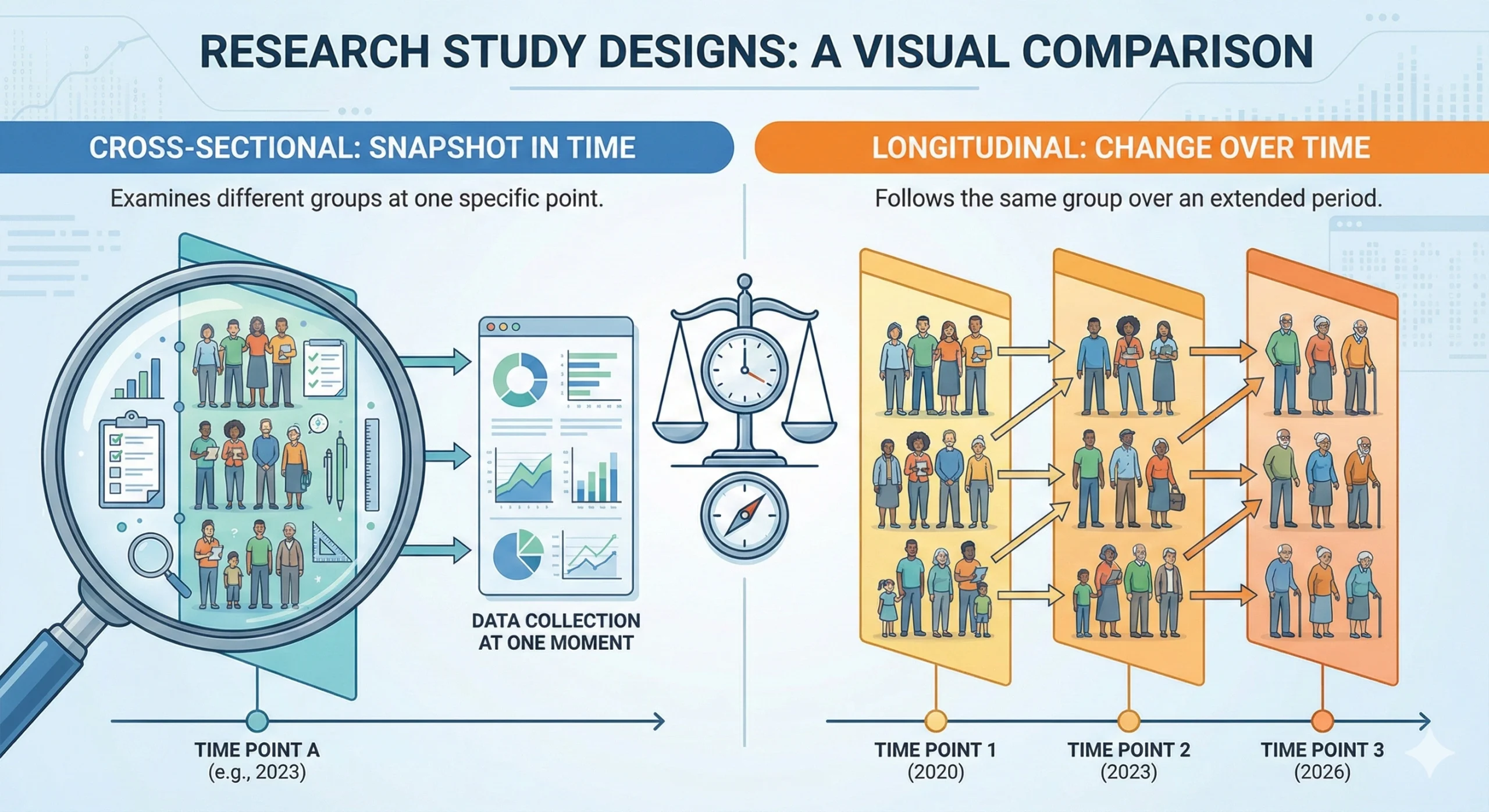
Cross-sectional research represents the data at one stage. You will make comparisons between groups, estimate prevalence, and analyse relationships between variables. They respond to such questions as: How common is this? And what factors are related to this outcome? These are cost-effective and popular designs.
Longitudinal = A Movie
Longitudinal studies are based on measurements of the same subjects at different times. You trace change, learn about the temporal sequence, and analyse development lines. They respond to such queries as How will this change and What will happen later? An example of this kind of survey panel in political science is a voter attitude tracking survey over election years.
The Best Use-Cases Decision Guide
- Application Cross-sectional: When Descriptive and Rapid Answers are needed. Select cross-sectional designs to estimate prevalence, to identify correlates, to compare across populations, or to develop hypotheses. A snapshot will suffice to answer whether someone is in favour of a policy or not, or whether income is related to voting.
- Longitudinal: When you require Change, Direction, or Causal Clues. Select longitudinal designs to track change patterns, policy effects over time, pre- and post-intervention effects, or cohort variation. Typical ones are panel studies of the same people, cohort studies of groups that experience something, and repeated cross-sections of different samples at multiple times. When causal inferences are sought, publication expectations of methodology in Wiley journals tend to stress justification of longitudinal methodology.
- One Easy Truth: Question Words Reveal the Design. The design of the questions that begin with how common and what is associated ” tends toward cross-sectional designs. Designs toward longitudinal research are those questions that ask how it changes or what predicts later outcomes. Not setting your design to your question leads to later mistakes of having off-point claims.
What You Can and Can’t Claim?
Temporal Order and Causality
Cross-sectional studies have problems with direction. Is it distrust that leads to media consumption, or is it distrustful people that drives them to different media? Not even by a snapshot can you tell. Longitudinal studies enhance temporal argument due to their ability to determine whether the cause is before the outcome. Nonetheless, confounding is also an issue, and causal claims are in need of cautious design and analysis.
Generalizability and External validity
The two designs rely on the quality of sampling. The samples taken at a cross-section can be generalised to a population at a given time point. There can be a problem of attrition in a longitudinal study that will lead to loss of generalizability across waves. The transparency of reporting, which the kind Mars Publications recommends, is being forthright about these restrictions, no matter what the design is.
Design Pitfalls That Derail Studies
- Cross‑Sectional Pitfalls: The reality is hidden by confounding. Direction is ambiguous in reverse causality. The timing effect counts, as the attitude of a survey following an election will be different compared to a survey in the middle of the term. Common-method bias overstates the correlations in circumstances where all measurements are based on the same measure at the same time.
- Longitudinal Pitfalls: Attrition alters your sample as time passes. Panel conditioning implies that the respondents can switch behaviour due to the study. The analysis is made complicated by missing waves. Measurement drift is a change in instruments or the practice of coding. Longitudinal studies are more difficult to maintain due to costs and time limitations. Such problems present in studies of political science often follow voters over several election cycles.
The Practical Setup: How to Plan Every Design?
Sampling and Measurement Consistency
Delimit your population. In longitudinal studies, maintain measurement instruments as constant as possible between the waves. Have planners make sense credits of your construct, monthly on volatile attitudes, yearly on stable traits.
How to analyse the book in plain English?
Cross-sectional analysis usually consists of group comparisons or controls with confounding. Change scores, fixed-effects models or growth curves can be used in longitudinal analysis. Wiley is known for its method transparency, or explaining how you chose to do what you did to allow your readers to judge.
Reporting Checklist
Essentials of Cross-Sectional Reporting
- Record the time of data collection
- Report on your sampling frame and response rate
- Name important measures and their characteristics
- Admit constraints in relation to direction and cause
Reporting Staples: Longitudinal
- Report every wave and the time difference between waves
- Explain your approach to attrition and missing data
- Measurement invariance is appropriate
- Describe how you are going to analyse repeated observations
It is also important to avoid excluding anything vital by adopting the editorial checklist attitude that Mars Publications encourages.
Conclusion
Snapshots attribute the existence of something at a single moment. Movies describe transformation with time. None of them is necessarily superior. Your question of research is the key to the right design.
Make your design with what you wish to claim. Cross-sectional is the one to use in case you require prevalence and associations. When you need direction and change, then select longitudinal. Then disclose your practices so that readers may judge your facts.
Regardless of the field of your work, political science, sociology, or education, this separation informs your work in and out of data collection to publication. Get it conscious, and your assertions will be firmer.