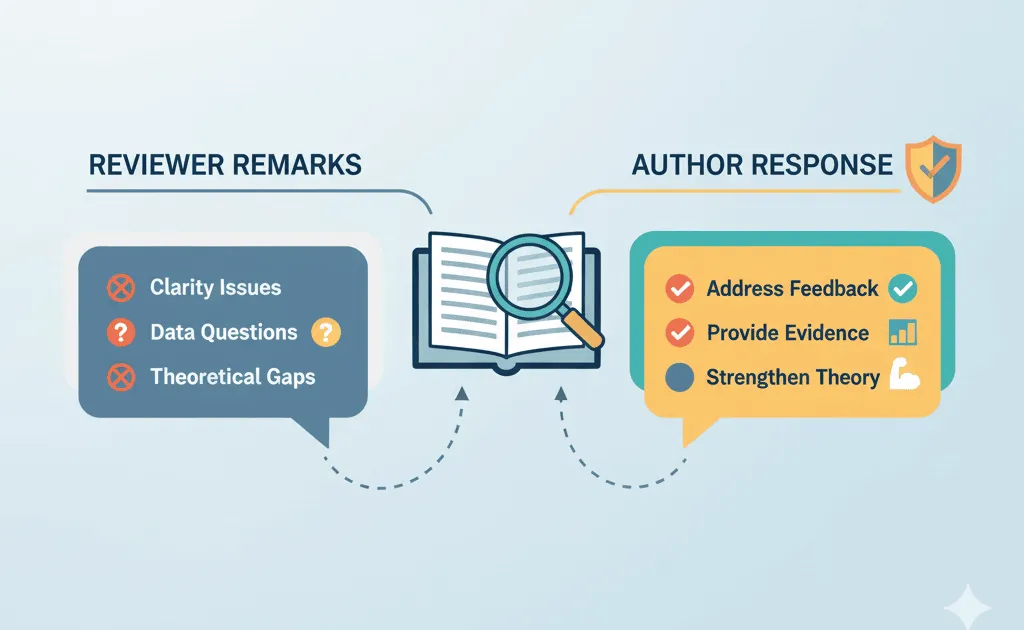
Linguistics Researchers can relate that submitting a paper to a reputable journal is just one of the tasks. The real problem begins when reviewers post comments, which can be discouraging. These comments are meant to assist you, but they may be stressful, especially when they involve technical details. This blog provides guidance on how to respond effectively, which can make the difference between rejection and acceptance of your paper. At Mars Publications, we offer Reviewer Comment Support Services to help linguistic research authors navigate this process with confidence. We enhance clarity and feedback response in the right way, ensuring that revisions meet the journal’s expectations. The following are some common reviewer comments that Linguistic research Papers receive during the review process.
The Research Question Needs a Clearer Definition
One of the most frequent criticisms of the research question is that it is too broad, vague, or does not align with the study’s methods. Critics seek an objective, which is well-grounded. A general question may cause results to appear disjointed in linguistic studies, where data may be phonetic corpora or syntactic analysis.
Write your primary question in a single or two short sentences. For example, rather than stating that this paper investigates language change in digital communication, write that this paper examines how the use of emojis indicates pragmatic change in informal online conversations among English speakers aged 18-30.
Next, revise your abstract, introduction, and conclusion to ensure consistency. The editing professionals at Mars Publications will help you align your work with the expectations of the reviewers.
The Literature Review Is Outdated or Incomplete
The field of linguistics evolves rapidly, and each year, new works emerge in the fields of computational linguistics, psycholinguistics, and sociophonetics. The reviewers might think that you have not read the latest discussions or omitted essential sources. This demonstrates a lack of awareness of existing studies.
Include 5-10 new sources (within the past five years) of the best journals. Organize your review by theme, area, theory, or approach, not by year.
Sample answer: We have included recent research on corpus-based discourse analysis (Smith, 2023; Liu and Carter, 2022), which can be used to justify our framework.
This demonstrates that you are current and have academic development.
Methodology Is Insufficiently Described
The methodology is credible in the field of linguistics. Missing information regarding sampling, transcription, coding, or analysis is frequently mentioned by reviewers.
Writers might believe that there is no need to explain standard techniques (such as IPA transcription or thematic coding). However, critics, particularly those in other professions, demand specificity.
State, where data was obtained, and tools (e.g., ELAN, Praat, NVivo).
Data collection steps (ethics or consent) List.
Describe how you will analyze it- e.g., a mixed-methods analysis that will involve frequency counts and discourse interpretation.
Precise details build trust. Our services help authors to develop their approaches to journal standards.
Results Lack Sufficient Interpretation or Context
The results section is frequently criticized as merely reporting numbers without connecting to theory.
The authors present data (tables, examples) but do not explain their meaning.
Relate results to your theory. Examples: The increase in terminal intonation confirms Gussenhoven’s (2004) assertion that intonation serves as an indicator of stance.
Compare with previous research- reviewers desire depth, not description.
Discussion and Conclusion Sections Overlap or Repeat
Reviewers mark redundancy when the discussion and conclusion are the same.
In both sections, the authors repeat without new knowledge.
Discuss, interpret the results, connect them to theory, and mention any limitations.
Summarize significant findings, implications, and future research in the conclusion.
Good structure and editorial ability are demonstrated by clear separation.
Language and Clarity Need Improvement
Even good research may be rejected if the writing is unclear or contains grammatical errors. The typical comment of the reviewers is that the paper requires language polishing before publication.
Researchers can use jargon excessively or can write long, complicated sentences that conceal meaning.
Collaborate with academic English editors who maintain discipline in terms of. The editors of Mars Publications enhance the tone, grammar, and flow without removing technical language.
A refined paper is an indication of professionalism.
Figures, Tables, or Examples Are Inconsistent
Examples, phonetic transcriptions, syntax trees, or discourse excerpts should be uniform and properly formatted.
Authors combine notation or omit glossing conventions, which makes it difficult to read.
Assign one number to all examples.
Insert interlinear glosses according to Leipzig Glossing Rules.
Prepare figures and tables in the format required by the journal.
Determination is accurate, which is appreciated by reviewers.
The Paper Lacks a Theoretical or Practical Contribution
Reviewers would like to understand what your study contributes to the knowledge.
Writers can provide descriptive findings without referring to bigger arguments.
Discuss the way your results improve or contradict current models.
Include practical implications to teaching, translation, or NLP where applicable.
Conclude with a clear statement of added value. Example: This work builds upon politeness theory by introducing multimodal online discourse data.
This puts your work in the context of being original and influential.
Reference Listing: Incomplete or Formatted Incorrectly.
Strict styles such as APA or Harvard are applied in linguistics journals.
References Are Incomplete or Incorrectly Formatted
Minor slip-ups, such as missing DOIs, incorrect capitalization, or missing entries, demonstrate a lack of attention to detail.
How to respond:
Enter the information into Zotero or EndNote, and then verify each record against the journal instructionsensuring clean, error-free bibliographies.
Authors Did Not Fully Address Previous Reviewer Feedback
This is especially critical in resubmissions. Reviewers expect to see point-by-point responses
Prepare a Response to Reviewers Document with:
- Reviewer comment (quoted)
- Your response (explaining revisions made)
- Page and line numbers showing changes
Be respectful and appreciative, even when disagreeing. Use evidence to justify any decision not to revise as suggested. Our Reviewer Comment Support Services specialize in drafting and structuring such documents to enhance acceptance rates.
Conclusion
Responding to reviewer comments is both an art and a science. Linguistics authors who approach feedback thoughtfully, clarifying research design, improving structure, and refining language, transform critiques into opportunities for growth. By recognizing the most common reviewer remarks in linguistics journals and addressing them with professionalism, you not only strengthen your paper but also demonstrate scholarly maturity.
At Mars Publications, our Reviewer Comment Support Services offer expert assistance, from revising unclear sections to crafting precise responses. Whether your paper falls under sociolinguistics, syntax, or computational linguistics, our specialists ensure it meets the expectations of reviewers and the journal’s standards. Your research deserves to be published and recognized. Let us help you turn reviewer feedback into a pathway to publication success.