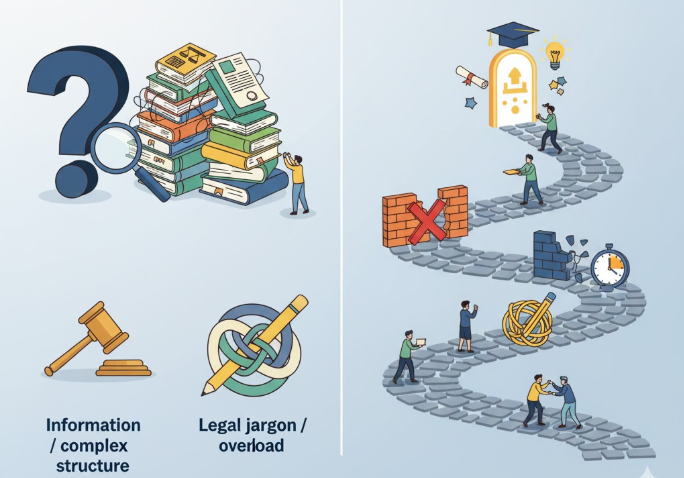
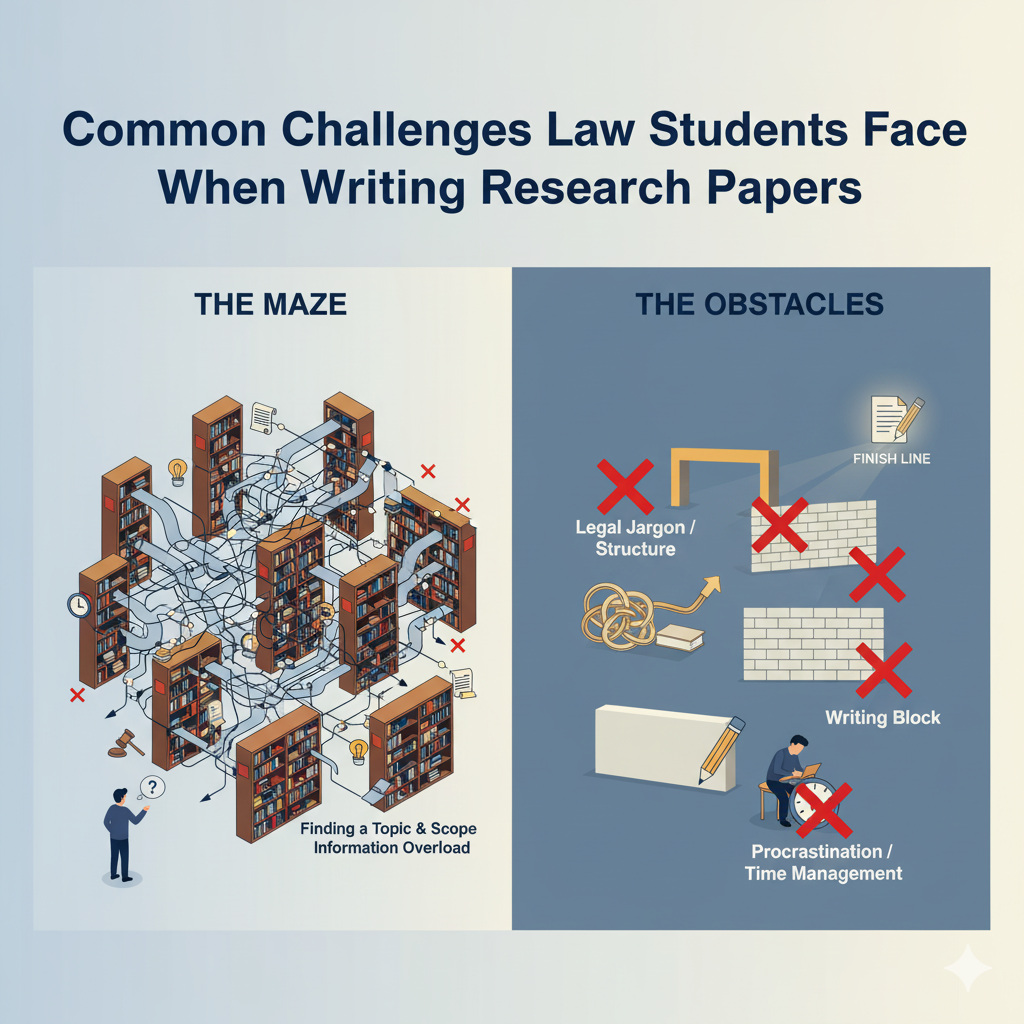
Writing a research paper in law is unlike writing in any other discipline. It requires not just academic clarity but also analytical precision, mastery of legal reasoning, and adherence to strict formatting and citation guidelines. For law students, the process can be intellectually demanding and procedurally complex. Understanding the common challenges can help students prepare better and avoid pitfalls that often weaken their legal arguments.
The following are the key challenges that law students encounter, and how quality and confidence can be enhanced with the help of Legal Research Paper Support by Mars Publications.
Choosing a Narrow, Researchable Topic
Law students typically start with general concepts, such as human rights violations or environmental law. These are too broad to be analyzed as a legal matter. It is more effective to identify a particular legal problem or a case question that can be argued, compared to precedent, and interpreted in light of statutes. For example, rather than cyber law, one can examine the legal implications of AI-based evidence in cybercrime trials. A strong topic should:
- Resolve an existing or evolving legal problem.
- Case law, statutes, and scholarly commentary.
- Permit argument and counter-argument.
Research or academic editors can help students narrow down their general interests into publishable ones.
Difficulty in Finding Reliable Legal Sources
Law is based on primary sources, such as statutes, case law, and legal opinions, as well as secondary sources, including commentaries and law-review articles. Many students struggle to work with databases, overlook important precedents, or rely on non-authoritative sources.
To resolve this, students are supposed to:
- Access databases like LexisNexis, HeinOnline, and Westlaw.
- Never ignore jurisdiction and date of cases.
- Include secondary literature to provide an academic context.
Professional Legal Research Paper Support services, such as those offered by Mars Publications, typically involve researchers who can locate authoritative and up-to-date materials, thereby enhancing the credibility of the paper.
Organizing the Argument Logically
One of the challenging tasks is to structure complex legal arguments clearly and convincingly. A law paper should have a balance between background facts, identification of issues, legal analysis, and conclusions, and should have a logical flow.
A good legal paper is written using the IRAC (Issue, Rule, Application, Conclusion) or some other method that fits the assignment. Students tend to lose track of placing facts before rules or confuse the reader with analysis and opinion.
Collaborating with editors who are proficient in legal writing ensures a logical order and adherence to the journal’s or university’s requirements.
Misinterpreting or Overgeneralizing Case Law
The reasoning of law relies on the accurate interpretation of the language of the law. Even a minor misunderstanding of a ratio (the legal principle of a case) can shatter a whole argument. Many students also refer to cases from other jurisdictions, assuming they are applicable everywhere.
To avoid this:
- Read entire judgments, not only headnotes.
- Contextualize precedents- know the facts, not the result.
- Check cases against each other and use them.
Weak interpretations of the cases or poor citations can be identified by expert editors who specialize in the clarity of legal writing.
Citation and Formatting Mistakes
Depending on the region or journal, legal papers are written in a specific citation format, such as the Bluebook, OSCOLA, or Harvard Law Referencing. Marks or rejection can be lost due to wrong punctuation, capitalization, or order.
To prevent this:
- Legal styles: Use reference tools such as Zotero or Mendeley.
- Have a citation checklist.
- Seek the assistance of professional services to get formatting.
Balancing Objectivity and Advocacy
Law students are usually unable to remain objective and argue convincingly. Academic research should be logical, not emotional. Statements such as ‘the law is unfair’ are not worth anything unless supported by evidence or precedent. It is essential to argue, not to be argumentative.
A good tone in legal writing:
- Makes careful, evidence-based statements (it may be argued that).
- Preferring logic to rhetoric.
- Expects opposing arguments and responds rationally.
Managing Time and Revision Pressure
Legal writing involves extensive research, drafting, and editing cycles. Time constraints often lead students to rush citations or skip proofreading, which are common causes of low-quality submissions. Developing a research plan early and scheduling review sessions for each section can prevent last-minute panic.
Professional services offering Legal Research Paper Editing and Proofreading help law students refine their language, verify accuracy, and polish their flow under tight deadlines.
Ethical Standards in Legal Research
The consequences of plagiarism can be dire, particularly in professional training programs. Ethical writing does not imply only proper citation, but also does not imply distorting the results of cases or secondary interpretations.
Students should:
- Check plagiarism detectors before submission.
- Rewording with the original meaning in mind.
- Reference all sources and interpretations of data.
Conclusion
Legal research papers challenge a student’s reasoning, arguing, and interpreting the law skills within academic boundaries. In topic selection, specific citation, and so on, each step must be clear, structured, and ethical.
If you encounter any issues, Mars Publications’ Legal Research Paper Support can assist you by guiding you on format, clarity, sourcing, and final proofreading. It is not only about having the paper accepted but also about demonstrating your entire analytical capability as a future legal scholar.